

Electric trucks are becoming a more realistic option for commercial fleets across Ontario. For a fleet based in Mississauga or elsewhere in the GTA, the real question is not whether electric trucks work. It is whether their advantages fit the routes your trucks actually run.
Electric trucks can offer lower energy use, fewer diesel-specific maintenance requirements, regenerative braking, quieter operation, and zero tailpipe emissions. But range, payload, winter conditions, charging, and purchase cost still need to fit the operation.
If you want to see how these considerations apply to a current Class 8 electric truck, our guide to the Volvo VNR Electric covers its range, charging, and practical fleet considerations.
Why Are More Fleets Considering Electric Trucks?
Electric trucks have moved beyond early demonstrations. Manufacturers are now building battery-electric trucks for delivery, regional transportation, drayage, municipal work, and other commercial applications.
For many fleets, local and regional routes are the easiest place to start.
Consider a truck that leaves a Mississauga distribution centre in the morning, makes deliveries around Brampton, Vaughan, Toronto, and Milton, then returns to the same yard that evening.
The fleet already knows roughly how far that truck travels and how long it normally sits between shifts.
That makes it easier to evaluate than a long-haul tractor that may travel hundreds of kilometres in different directions every week.
Electric powertrains are only one of several changes affecting commercial transportation. Our article on the future of the trucking industry looks at other technologies and operating trends shaping heavy-duty fleets.
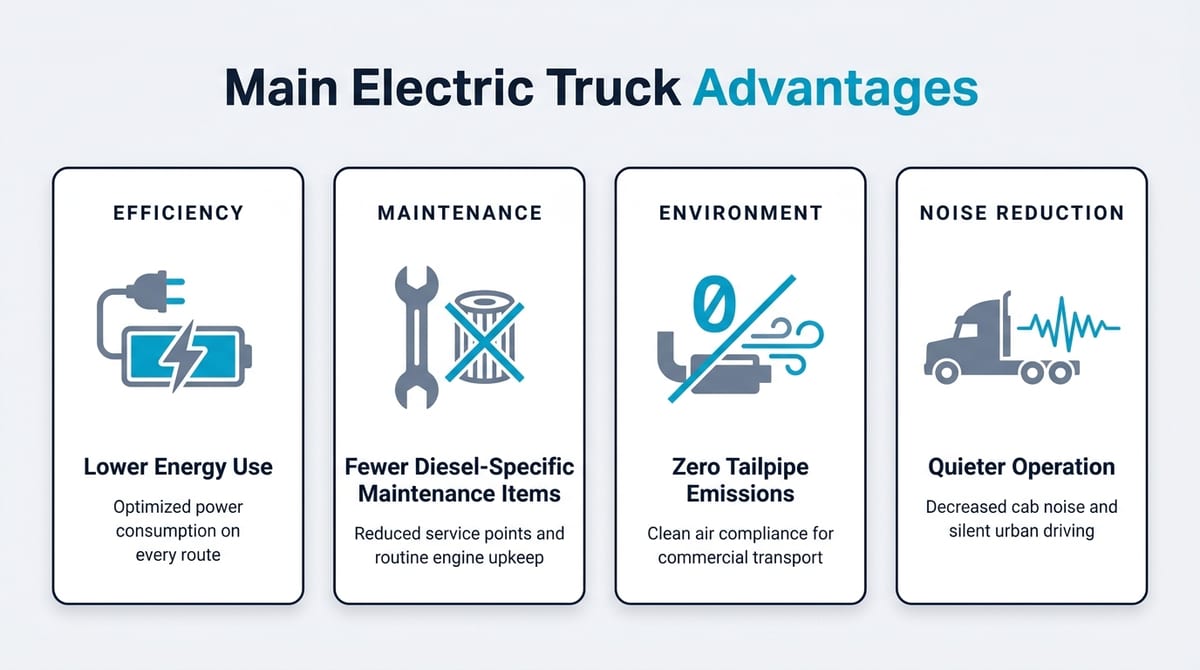
What Are the Main Electric Truck Advantages?
1. Lower Energy Use
Electric motors use energy more efficiently than conventional diesel engines.
A diesel engine loses a significant amount of energy through heat and mechanical processes. An electric drivetrain can use a larger share of its stored energy to move the truck.
For a commercial vehicle covering thousands of kilometres each month, that difference can become meaningful.
Electricity may also cost less per kilometre than diesel in some fleet applications, particularly when trucks can charge at a fleet facility during the time they would already be parked.
Actual operating cost still depends on electricity rates, mileage, charging requirements, payload, and how the truck is used.
2. Fewer Diesel-Specific Maintenance Items
An electric truck does not have the same engine, fuel, and exhaust systems found on a conventional diesel truck.
That removes several familiar service requirements, including:
- Diesel engine oil changes
- Engine oil filters
- Fuel filters
- DEF-related maintenance
- Diesel particulate filter servicing
- Some exhaust aftertreatment components
This can simplify part of the maintenance schedule.
It does not eliminate maintenance.
Electric trucks still rely on systems such as:
- Tires
- Steering
- Suspension
- Brakes
- HVAC
- Cooling systems
- Pumps
- Battery thermal management
- High-voltage electrical components
As fleets begin operating electric and diesel trucks together, correct part identification becomes even more important. Our guide on how to choose the right semi-truck parts explains what to check before ordering a replacement component.
3. Regenerative Braking
Electric trucks can recover some energy while slowing down.
Instead of relying entirely on conventional friction brakes, regenerative braking uses the electric motor to help decelerate the vehicle while returning energy to the battery.
That can be particularly useful on routes with frequent stops.
Around the GTA, a truck may repeatedly slow down and accelerate on the 401, 427, QEW, local industrial roads, and delivery routes.
Regenerative braking can also reduce how much work the conventional friction brakes need to perform, although those brakes still require regular inspection and maintenance.
4. Strong Torque at Low Speed
Electric motors can deliver strong torque immediately from a standstill.
For a heavy truck, that can provide smooth power delivery when moving away from:
- Loading docks
- Traffic lights
- Distribution centres
- Highway ramps
- Stop-and-go traffic
The advantage is not simply faster acceleration. It is the way the electric drivetrain delivers power without needing to build torque through the same engine and transmission process as a diesel truck.
5. Quieter Operation
Electric trucks produce far less engine noise and vibration than diesel trucks.
For a driver spending an entire shift in the cab, that can create a quieter and more comfortable working environment.
It can also help during early-morning or late-night deliveries around warehouses, loading docks, residential areas, and distribution centres.
Tire, road, wind, and HVAC noise still remain, but the diesel engine itself is no longer a major source of sound.
6. Zero Tailpipe Emissions
Battery-electric trucks produce no tailpipe emissions while driving.
That can be valuable for trucks working around:
- Urban areas
- Warehouses
- Distribution centres
- Municipal operations
- Customer facilities
- Densely populated neighbourhoods
Zero tailpipe emissions does not mean the truck has no environmental impact. Battery production and electricity generation still need to be considered.
The advantage is that the vehicle itself is not producing diesel exhaust during operation.
7. Less Energy Used While the Truck Is Stopped
A conventional diesel truck can continue consuming fuel while sitting in traffic or waiting at a loading dock.
An electric drivetrain does not need to keep an internal-combustion engine running simply because the truck is stationary.
Heating, cooling, and other electrical equipment can still use battery power, but energy is not being spent just to keep a diesel engine idling.
For delivery trucks spending a lot of time in GTA traffic or customer yards, that difference can add up over the working day.
Where Do Electric Trucks Make the Most Sense?
Electric trucks are easier to integrate when the job is predictable.
A good candidate may be a truck that:
- Travels a similar distance each day
- Returns to the same yard regularly
- Has predictable downtime
- Operates mainly on local or regional routes
- Makes frequent stops
- Has reliable access to charging
The important point is predictability.
A truck that runs the same Mississauga-to-GTA delivery routes every day gives a fleet manager much more control over range and charging than a truck whose destination changes constantly.
Electric Truck vs. Diesel Truck
Electric trucks are not automatically better than diesel trucks for every application.
Electric trucks are easier to justify when routes are predictable, and the vehicle regularly returns to a known charging location.
Diesel still has practical advantages for:
- Long-haul transportation
- Remote routes
- Unpredictable schedules
- Heavy-duty applications
- Operations where rapid refuelling is essential
That means mixed fleets are likely to remain common.
For example, a business may use electric units on predictable regional routes while its existing Volvo diesel trucks continue handling other work. When those conventional trucks need maintenance, you can still search for available Volvo truck parts by application.

What Should You Consider Before Buying an Electric Truck?
Look at Your Actual Route
Do not start with the maximum range printed in a brochure.
Start with dispatch records.
Review:
- Average daily distance
- Longest regular route
- Typical payload
- Number of stops
- Highway versus city driving
- Time between shifts
- Seasonal changes
A truck that can complete the route only under ideal conditions leaves little margin for colder temperatures, heavier loads, traffic, or route changes.
Payload demands require particularly careful evaluation. Heavy battery packs add significant curb weight, which directly diminishes cargo carrying capacity compared to a conventional diesel truck. To help offset the weight of onboard batteries, weight limits are governed at the provincial level rather than by a nationwide mandate, with varying rules by province (such as British Columbia’s 1,500 kg allowance for battery-electric trucks) rather than a uniform 1,000 kg Canadian GVWR allowance. Even with that buffer, fleets carrying heavy or dense freight need to verify that their loaded weights remain compliant without forcing a cut to usable payload.
Consider Ontario Winter Conditions
Cold weather needs to be part of the calculation.
Battery thermal management and cabin heating both require energy, which can affect available driving range during winter.
For a fleet based in Mississauga, the important question is whether the truck can comfortably complete its normal January or February route.
Summer range alone does not answer that question.
Make Sure Charging Fits the Schedule
For a truck that returns to the same yard every evening, charging may fit naturally into the existing schedule.
The fleet still needs to consider:
- How long the truck normally remains parked
- Charger requirements
- Available electrical capacity
- Whether several trucks will eventually charge together
- Future fleet expansion
The goal should be to make charging fit the existing operation rather than changing the entire dispatch schedule around the charger.
Compare the Full Cost
Electric trucks can have a higher upfront purchase price than comparable diesel trucks.
A useful comparison should therefore look beyond the purchase price and include:
- Financing
- Electricity
- Charging equipment
- Electrical upgrades
- Maintenance
- Annual mileage
- Downtime
- Expected ownership period
A truck with a higher purchase price can still make sense if its operating profile allows the fleet to recover those costs over time.
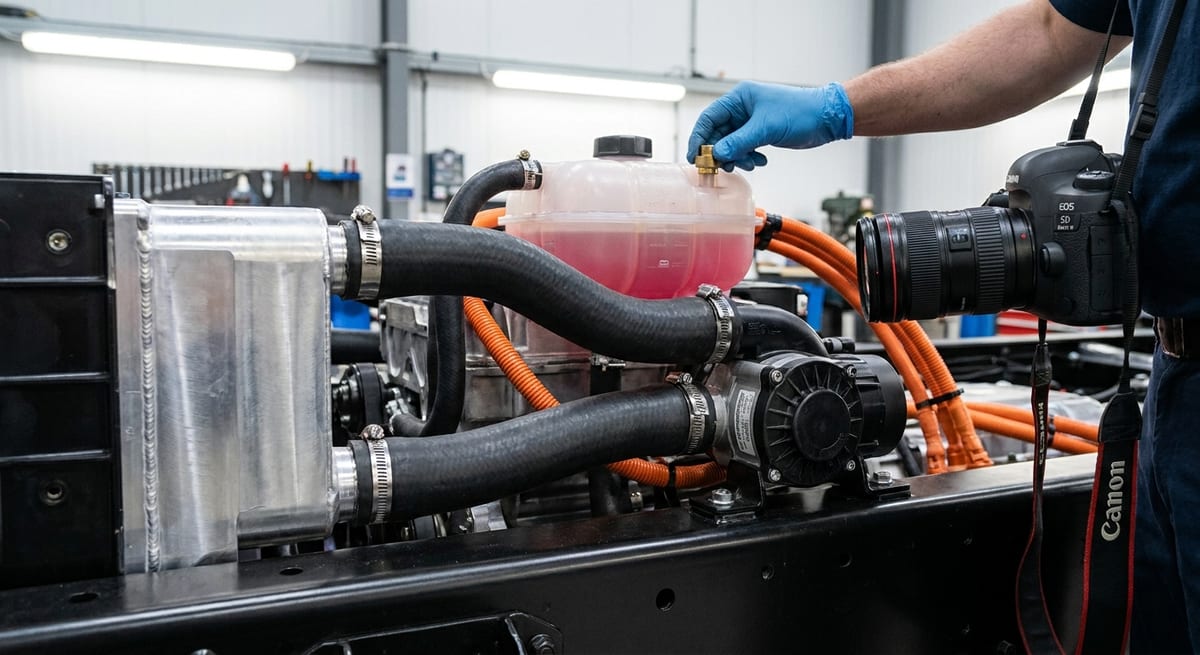
Do Electric Trucks Still Need Cooling Systems?
Yes. Removing the diesel engine does not remove heat from the vehicle.
Battery packs, electric motors, inverters, and other power electronics need to operate within controlled temperature ranges. Depending on the vehicle, the thermal-management system may use coolant, pumps, reservoirs, fans, valves, and heat exchangers.
Those components are not necessarily interchangeable with conventional diesel cooling parts.
If one of the diesel trucks in your fleet is running hot or losing coolant, read How to Repair a Truck Radiator before replacing major cooling-system components.
The key is to diagnose the problem first and confirm fitment before ordering.
Do Electric Trucks Still Need Air Conditioning?
Yes. Drivers still need heating and air conditioning regardless of what powers the vehicle.
An electric truck may use an electrically driven AC compressor rather than a compressor driven mechanically by a diesel engine.
The system and part numbers can therefore differ significantly from the conventional version of the same truck.
For diesel and other conventional trucks in a mixed fleet, Quick Fit Parts carries heavy-duty AC compressors across multiple truck applications.
Always match the replacement to the exact vehicle and system specifications.
Electric Trucks Still Need Maintenance
One common misconception is that electric trucks require almost no maintenance.
That is not the case.
The work changes.
Diesel trucks have engine, fuel, exhaust, and charge-air systems that battery-electric trucks do not use in the same way.
Electric trucks introduce high-voltage equipment, battery packs, electronic controls, and specialized thermal-management systems.
Both still rely on fundamental systems such as steering, suspension, brakes, tires, cooling, and HVAC.
For maintenance departments, the transition may actually mean supporting two different types of powertrain for several years.
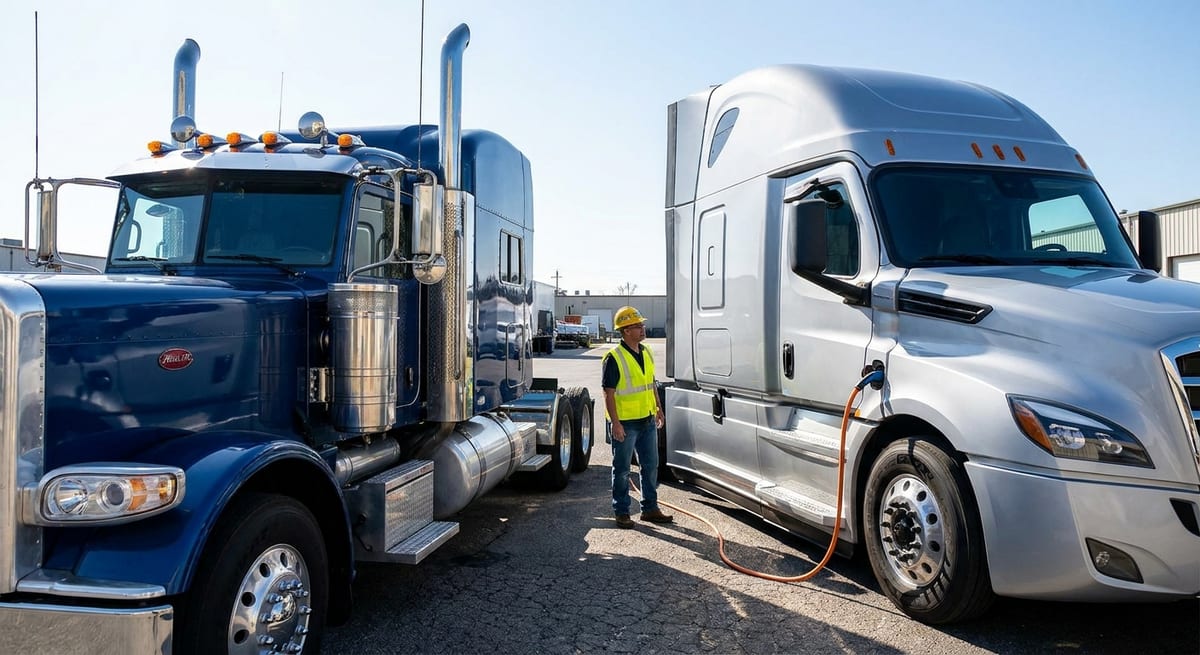
Should You Replace Your Diesel Trucks With Electric Trucks?
For most fleets, replacing every diesel truck at once is probably not the best way to evaluate electric equipment.
A better question is:
Which trucks already have routes that suit electric operation?
A local delivery unit running a consistent route may be a good candidate.
A tractor that regularly travels unpredictable long-haul routes may not be.
Some fleets may get better information by introducing one or two electric trucks first and tracking:
- Energy consumption
- Winter range
- Charging time
- Payload
- Driver feedback
- Maintenance
- Uptime
- Actual operating cost
That gives the fleet real operating data before committing to a larger change.
Frequently Asked Questions
What are the biggest advantages of electric trucks?
The main electric truck advantages include higher drivetrain efficiency, fewer diesel-specific maintenance requirements, regenerative braking, quieter operation, strong low-speed torque, and zero tailpipe emissions.
The financial benefit depends on the route, mileage, charging setup, vehicle price, and utilization.
Are electric trucks cheaper to operate than diesel trucks?
They can be in suitable applications. Electric trucks may offer lower energy costs and fewer conventional powertrain-maintenance requirements, but charging equipment and the higher vehicle purchase price also need to be considered.
Do electric trucks require less maintenance?
They eliminate several traditional diesel-engine maintenance items, but they still require regular service. Tires, brakes, steering, suspension, HVAC, cooling systems, battery thermal management, pumps, and electrical systems all require inspection.
How far can an electric semi truck travel?
There is no single range that applies to every electric truck. Range varies based on battery capacity, payload, temperature, speed, terrain, traffic, HVAC use, and vehicle configuration.
Fleet managers should compare expected real-world range with the truck’s actual route rather than relying only on the maximum advertised figure.
Do electric trucks work in Canadian winters?
Yes, but cold weather can increase energy consumption and reduce available range. Ontario fleets should compare expected winter performance with their longest regular routes before assigning an electric truck to the job.
Are electric trucks good for long-haul trucking?
Electric trucks can handle some longer routes, but long-haul operation is more difficult because range, payload, charging time, and charging availability all need to work together. Predictable local and regional work remains easier to plan around.
Do electric trucks still use cooling systems?
Yes. Electric trucks use thermal-management systems to control the temperature of batteries, motors, inverters, and electronics.
Depending on the vehicle, these systems may include liquid coolant, heat exchangers, pumps, reservoirs, fans, and control valves.

Write A Comment