
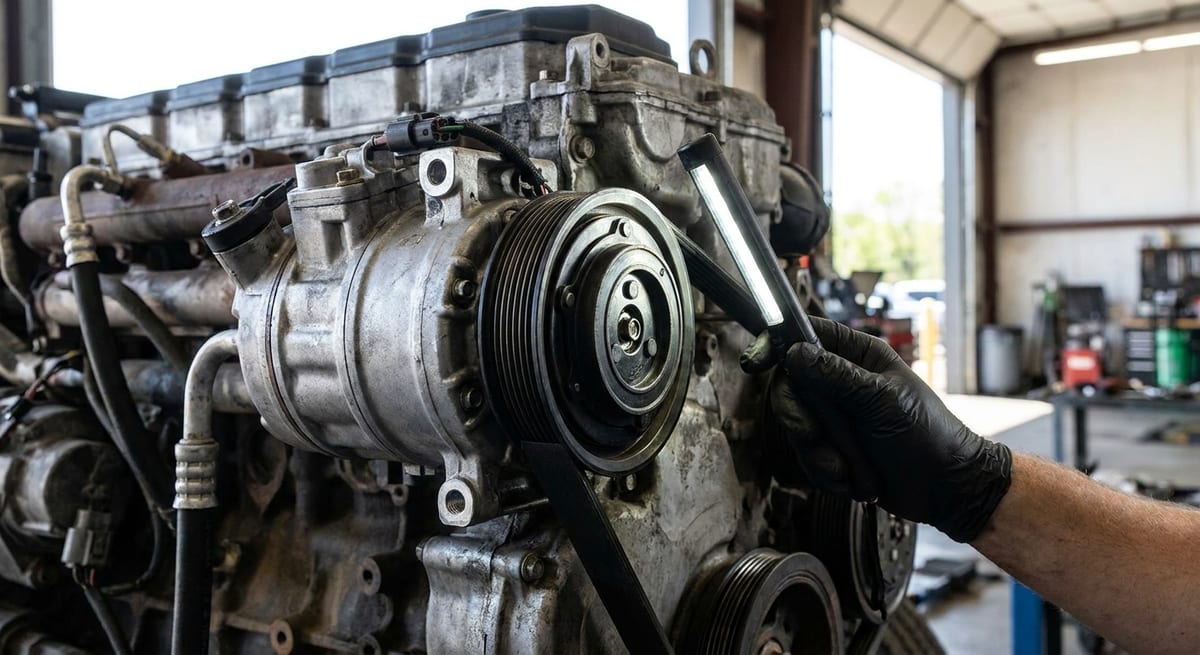
Every truck AC compressor has an electromagnetic clutch on the front. The pulley is driven by the engine belt and spins all the time, but the compressor only runs when the clutch locks that pulley to the compressor shaft. If you switch on the AC and the pulley turns while the centre hub stays still, the compressor is not kicking on because the clutch is not engaging. That does not automatically mean the compressor is bad. In most cases, the clutch is not getting the signal or the power it needs, and the fix is a switch, a fuse or a wiring repair rather than a new truck AC compressor.
This guide walks through the seven most common reasons a truck AC compressor clutch is not engaging, in the order a technician would check them, so you can avoid replacing parts that were never the problem. If the clutch does engage but the air is still warm, start with our guide on why a truck AC blows warm air instead.
How a Truck AC Compressor Clutch Engages
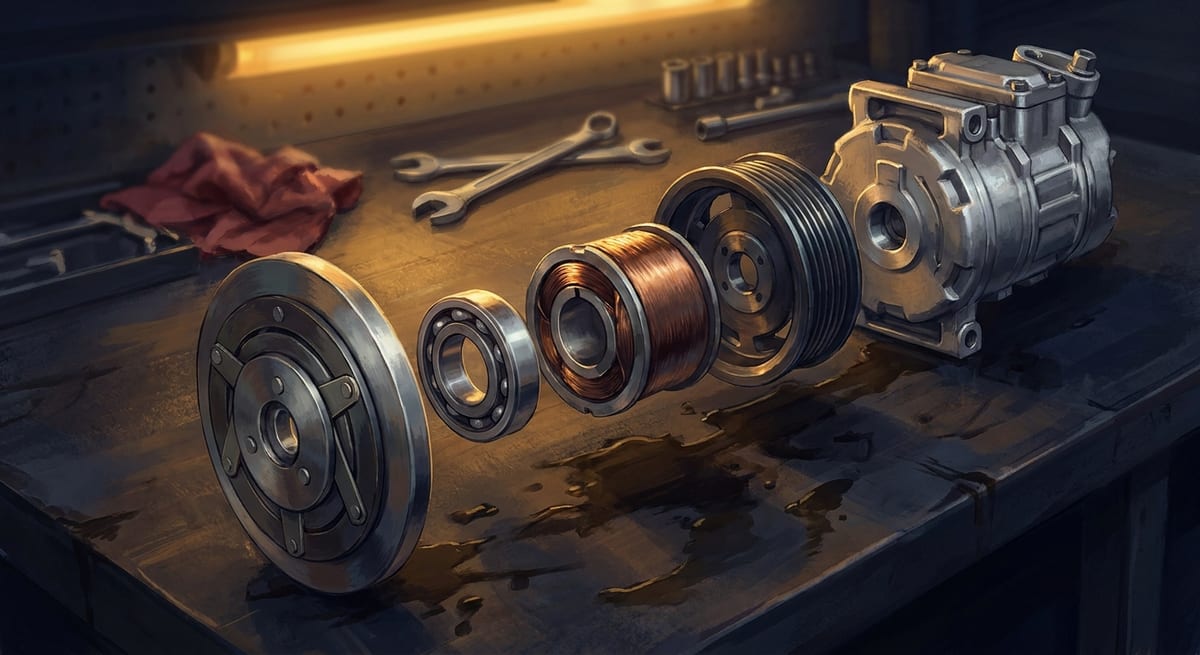
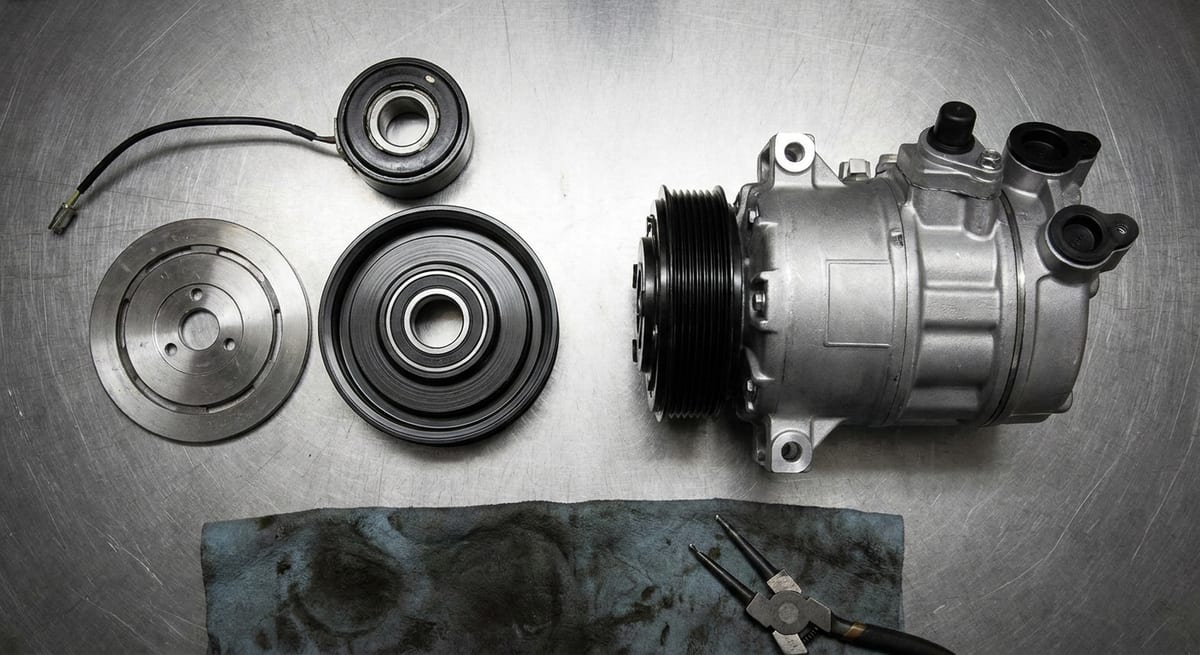
When the system calls for cooling, current flows to the clutch coil behind the pulley. The coil becomes a magnet and pulls the clutch plate against the pulley, so the pulley and the compressor shaft turn together. You will usually hear a click and see the hub start turning. When the current stops, a spring pulls the plate away and the pulley spins freely again.
For that current to arrive, several conditions have to line up:
- The driver requests AC from the dash, and the HVAC controller or engine ECM approves the request.
- System pressure is inside the safe range, so the AC pressure switch stays closed.
- The fuse and clutch relay pass power to the compressor connector.
- The coil, wiring and ground complete the circuit.
- The gap between the clutch plate and the pulley is small enough for the magnet to pull the plate in.
A break anywhere in that chain leaves the clutch disengaged. Each cause below matches one link in the chain.
7 Reasons a Truck AC Clutch Won’t Engage
1. Low Refrigerant Charge
The most common cause is also a protective one. When refrigerant leaks out, system pressure drops, and the low-pressure side of the AC pressure switch opens the circuit so the compressor cannot run without enough refrigerant and oil. The clutch stays off by design. Gauges will show low static pressure on both sides. A recharge alone is only a temporary fix: the leak has to be found, and if the system has been open for a while, the truck AC drier is usually due for replacement too.
2. Faulty AC Pressure Switch
The binary or ternary switch, usually mounted on the drier or a high-side line, can fail open even when pressures are normal. Corroded terminals and a broken internal diaphragm are typical failures. If the gauges show a normal charge but no voltage leaves the switch, the switch is the suspect. Replacement truck AC switches are matched by thread size, connector type and pressure settings, so check the old part number before ordering.
3. Blown Fuse or Failed Clutch Relay
A short in the clutch circuit, or a weak coil drawing too much current, can blow the AC clutch fuse. Relays fail from heat and vibration, both of which are constant on a heavy-duty truck. Swapping the clutch relay with an identical relay from another circuit is a quick way to test it.
4. Wiring, Connector or Ground Problems
The harness near the compressor sits next to engine heat, road spray and vibration. Chafed wires, a corroded connector or a loose ground can drop the voltage below what the coil needs. With the AC requested, check for battery voltage at the compressor connector. If voltage is present at the harness side but the clutch still does not respond, inspect the connector pins, the pigtail and the ground path.
5. Open or Shorted Clutch Coil
If full voltage reaches the connector and the clutch still does not pull in, measure the coil resistance with a multimeter and compare it with the compressor manufacturer’s specification. An open reading means the coil winding is broken. A reading far below the specification points to a shorted coil, which often blows fuses as well. Coils usually fail from heat, especially after a period of clutch slipping.
6. Excessive Clutch Air Gap
Each time the clutch engages, the friction faces wear a little. Over time, the gap between the clutch plate and the pulley grows until the magnetic field can no longer pull the plate across, particularly when the coil is hot. A clutch that engages on a cold start but drops out after a long run is a classic sign. Measure the gap with a feeler gauge and set it to the manufacturer’s specification with shims, or replace the clutch if the friction faces are worn.
7. No Signal From the HVAC Controller or Engine ECM
On modern trucks, the clutch is controlled electronically. The controller can refuse to engage it if the evaporator temperature sensor reports freezing conditions, if a cab sensor fails, or if the engine ECM cuts the AC because of high coolant temperature or heavy engine load. Reading fault codes is the fastest way to confirm this. Because an engine running hot can disable the AC, cooling problems such as a clogged radiator should be ruled out first; our guide on diagnosing and repairing a truck radiator explains what to look for.
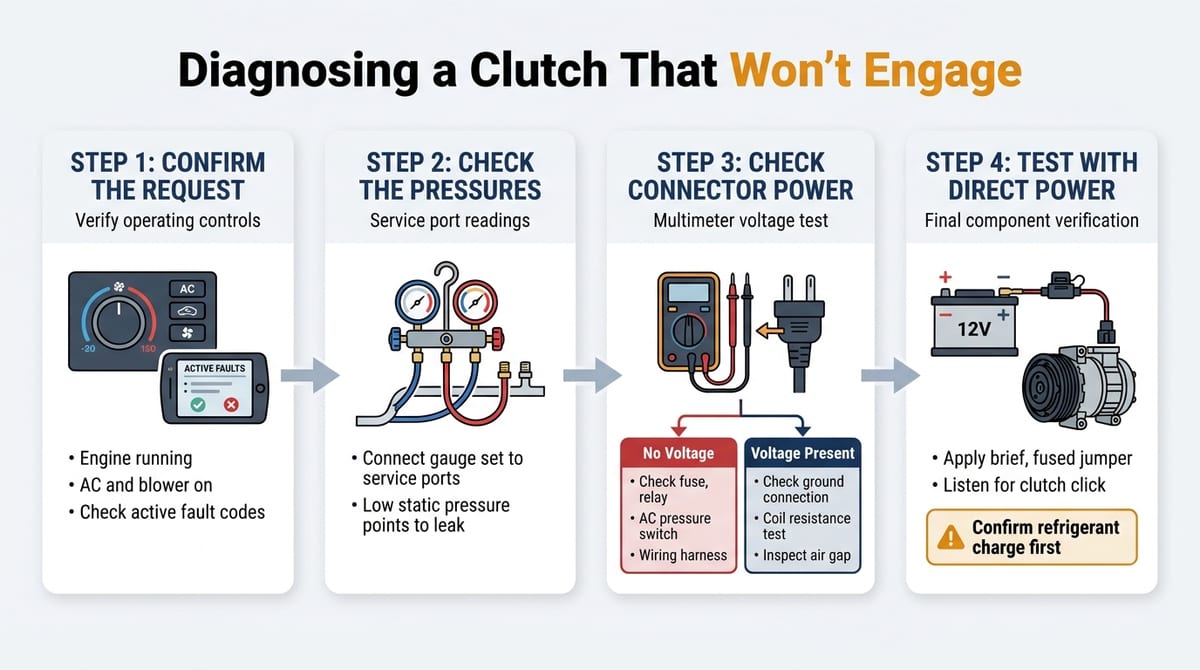
Diagnosing a Clutch That Won’t Engage, Step by Step
- Confirm the request. Engine running, AC on, blower on. Check for active fault codes.
- Check the pressures. Connect a gauge set to the service ports. Low static pressure points to a leak (cause 1). Refrigerant handling should be left to a certified technician.
- Check power at the compressor connector. Battery voltage with AC requested rules out the fuse, relay, pressure switch and controller.
- No voltage? Work backward through the fuse, relay, AC pressure switch and wiring.
- Voltage present? Check the ground and coil resistance, then the air gap.
- Test with direct power. A brief, fused jumper from the battery to the clutch connector should make the clutch click in. Only do this when the refrigerant charge is confirmed, because running the compressor without refrigerant and oil can damage it quickly.
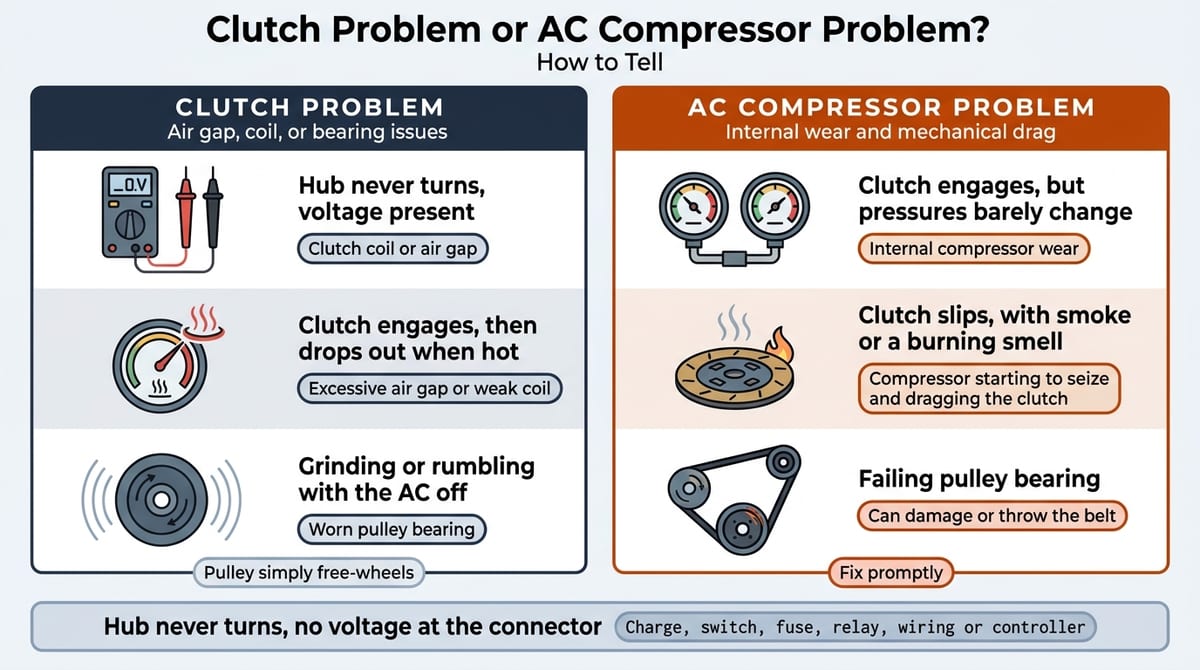
Clutch Problem or AC Compressor Problem? How to Tell
| What you see | Most likely cause |
|---|---|
| Hub never turns, no voltage at the connector | Charge, switch, fuse, relay, wiring or controller (causes 1 to 4 and 7) |
| Hub never turns, voltage present | Clutch coil or air gap (causes 5 and 6) |
| Clutch engages, then drops out when hot | Excessive air gap or weak coil |
| Clutch engages, but pressures barely change | Internal compressor wear |
| Clutch slips, with smoke or a burning smell | Compressor starting to seize and dragging the clutch |
| Grinding or rumbling with the AC off | Worn pulley bearing |
A clutch that stays disengaged does not stop the truck from running, because the pulley simply free-wheels. The exception is a failing pulley bearing: if it seizes, it can damage or throw the belt that also drives other engine accessories, so a noisy bearing should be fixed promptly.
Clutch-Only Repair vs. Full AC Compressor Replacement
If the compressor itself is healthy, meaning it builds normal pressure, has no shaft seal leak and turns smoothly by hand, many compressors accept a new clutch assembly made up of the plate, pulley, bearing and coil. On many designs, the clutch can be replaced without opening the refrigerant circuit.
Replace the whole compressor when it is seized, noisy inside, leaking at the shaft seal, or when the old clutch failed because the compressor was dragging. An internal failure sends debris through the system, so the drier, expansion valve and oil also need attention. Our guide on what else to replace with an AC compressor covers the full list. When ordering a replacement, match it by OEM number, clutch groove count and mounting pattern, and check whether your truck runs a Sanden or another compressor make.
How to Keep the AC Compressor Clutch Working Longer
- Repair refrigerant leaks instead of topping the system up.
- Keep belt tension within specification.
- Inspect the clutch connector and ground at every PM service.
- Run the AC for a few minutes regularly in winter to keep seals lubricated.
- Do not ignore a slipping clutch; the heat it creates damages the coil.
Frequently Asked Questions
What does the clutch do on a truck AC compressor?
It connects the belt-driven pulley to the compressor shaft. The pulley spins whenever the engine runs, but the compressor only pumps refrigerant when the clutch engages.
Why won’t my truck AC compressor clutch engage?
The most common reason is a low refrigerant charge, which opens the AC pressure switch to protect the compressor. After that, check the fuse, clutch relay, wiring, clutch coil, air gap and controller signal, in that order.
Can low refrigerant stop the clutch from engaging?
Yes. When pressure drops below the switch’s cut-out point, the pressure switch opens the clutch circuit so the compressor does not run without enough refrigerant and oil.
How do I know if it’s the clutch or the compressor?
If the clutch never engages, the problem is usually electrical or in the clutch itself. If the clutch engages but the pressures barely change, or the clutch slips and smokes, the compressor is the likely cause.
Can I replace just the AC compressor clutch?
Yes, if the compressor builds normal pressure, does not leak at the shaft seal and turns smoothly. On many compressors, the clutch can be replaced without opening the refrigerant circuit.
Is it safe to power the clutch directly from the battery?
Only briefly, through a fused jumper, and only when the refrigerant charge is confirmed. Running the compressor without refrigerant and oil can damage it quickly.
Can I keep driving if the AC clutch won’t engage?
Generally yes, because the pulley free-wheels and the engine is not affected. The exception is a failing pulley bearing, which can damage or throw the drive belt if it seizes.
Find the Right Replacement Part
A truck AC compressor clutch not engaging is often a switch or wiring fault rather than a failed compressor, so work through the causes in order before ordering parts. Once the faulty component is confirmed, browse our truck AC compressors and AC switches, and match the replacement by OEM number to make sure it fits your truck.

Write A Comment