

Two small heat exchangers sit inside many truck HVAC housings, and both can look like miniature radiators. One helps cool the cab; the other provides heat. Confusing them can mean ordering the wrong part or replacing a component that was never responsible for the problem.
The basic difference is the fluid inside. A truck AC evaporator carries refrigerant and removes heat from cabin air. A heater core carries engine coolant and transfers heat into the air. They share parts of the ventilation system, but they belong to different fluid circuits.
Here is how to identify them, interpret common symptoms, and check the right details before ordering.
Truck AC Evaporator vs. Heater Core at a Glance
The comparison below applies to conventional engine-coolant heating and refrigerant-based air conditioning. Electric HVAC systems can use different arrangements.
| Detail | A/C evaporator | Heater core |
|---|---|---|
| Main job | Removes heat and moisture from passing air | Adds heat to passing air |
| Fluid inside | A/C refrigerant | Engine coolant |
| Connected circuit | Refrigeration circuit | Engine cooling/heating circuit |
| Connections to identify | Refrigerant lines, sometimes through a valve or manifold | Coolant supply and return hoses or pipes |
| Possible leak consequence | Refrigerant loss and reduced cooling | Coolant loss, sometimes with odour or cabin dampness |
| Ordering priority | OEM reference, core dimensions, fittings, and valve arrangement | OEM reference, dimensions, and coolant tube layout |
Neither appearance nor location alone is a reliable identifier. Follow the connections and verify the part number.
What Does a Truck AC Evaporator Do?
The evaporator is the heat exchanger inside the cab’s A/C air-handling system. As refrigerant evaporates inside its passages, it absorbs heat from air moving across the fins. The blower then sends that cooled air through the vents.
Moisture can also condense on the cold fins. That water should leave through the HVAC drain, which is why water dripping beneath a truck during A/C operation can be normal.
A restricted cabin filter or dirty evaporator surface can reduce airflow and cooling performance. A damaged or leaking core is a different problem: cleaning the fins will not repair a refrigerant leak.
When comparing truck AC evaporators, check the technical specifications rather than relying on a product photo. Similar-looking cores can have different connections or mounting arrangements.
What Does a Truck Heater Core Do?
In a conventional diesel truck, the heater core uses heat already present in the engine coolant. Hot coolant passes through the core while the ventilation system directs air across it and into the cab.
Weak cabin heat does not automatically mean the heater core needs replacement. The cause may involve coolant supply, engine operating temperature, a control valve where fitted, or an air-mixing problem inside the HVAC housing.
Heating and air conditioning also work together in some demisting modes. The system can remove moisture from the air and then warm it before directing it towards the windscreen. Selecting defrost therefore does not necessarily mean the A/C side is inactive.
How to Identify the Part on Your Truck
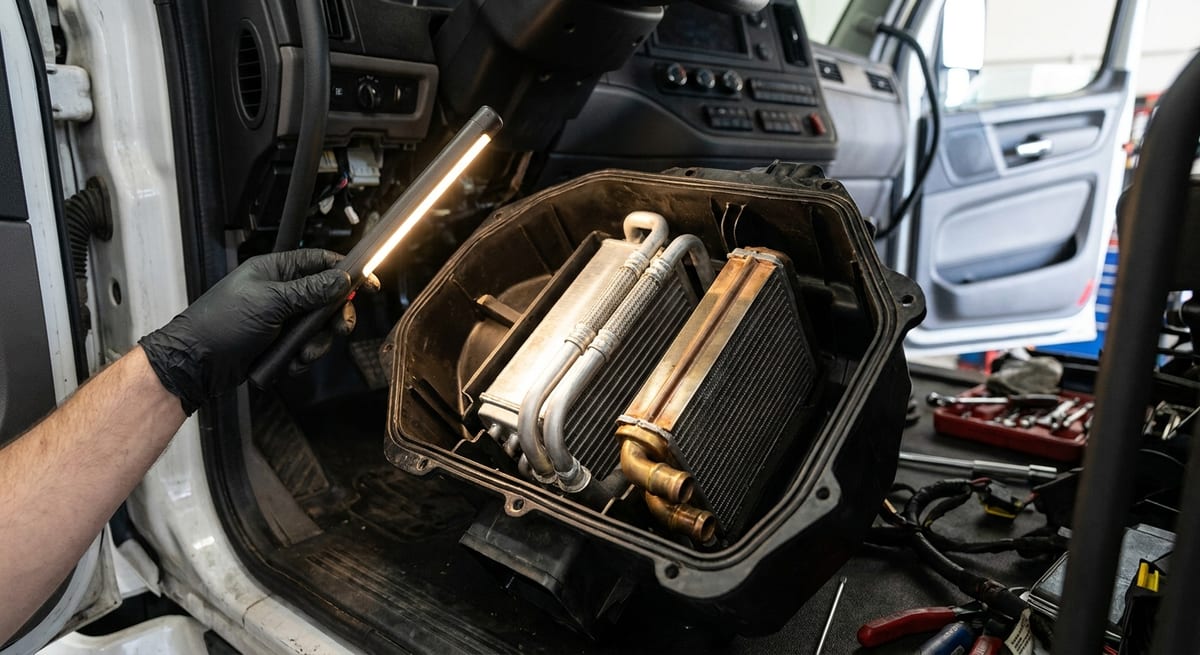
Trace the lines rather than judging the fins
Identify the pipes using the truck’s service information. Heater core connections lead into the coolant circuit. Evaporator connections belong to the refrigerant circuit and may meet at an expansion valve or connection block near the HVAC housing.
Do not identify either component by opening a line. Refrigerant and hot, pressurised coolant require the appropriate service procedures.
Check the HVAC unit and installation position
Record whether the part serves the front cab or a separate sleeper unit. Also note any HVAC manufacturer label or assembly number available on the housing.
A truck model name alone may leave several possible parts. Build date, cab specification, and previous repairs can affect what is actually installed. Photograph the old component’s connections and mounting points before comparing replacements.
Use dimensions to confirm the match
Compare core height, width, thickness, tube position, and overall dimensions. Core measurements describe the finned section; overall measurements include projecting tubes and fittings. Mixing those measurements can make a replacement look compatible when it is not.
Which Symptoms Point Towards Each Component?
Symptoms help narrow the investigation, but they do not identify a failed part on their own.
| Observation | What needs checking |
|---|---|
| Strong airflow but poor A/C cooling | Refrigerant charge, leaks, compressor operation, refrigerant flow, and temperature controls |
| Weak airflow on both hot and cold settings | Filter where fitted, blower, ducting, doors, and obstructed heat-exchanger surfaces |
| Poor heat after the engine warms up | Coolant condition and circulation, heater controls, and air-mixing operation |
| Sweet odour, unexplained coolant loss, or dampness near the heater housing | A possible heater core or coolant connection leak |
| Musty odour when the fan starts | Moisture, contamination, drainage, or filter condition; this does not establish a leaking evaporator |
| Wet cab floor | HVAC drainage, coolant leakage, and external water entry |
For example, a wet floor with no coolant loss could involve a blocked condensate drain. Replacing the heater core before identifying the liquid would miss the cause.
Diagnose Before Removing the HVAC Housing
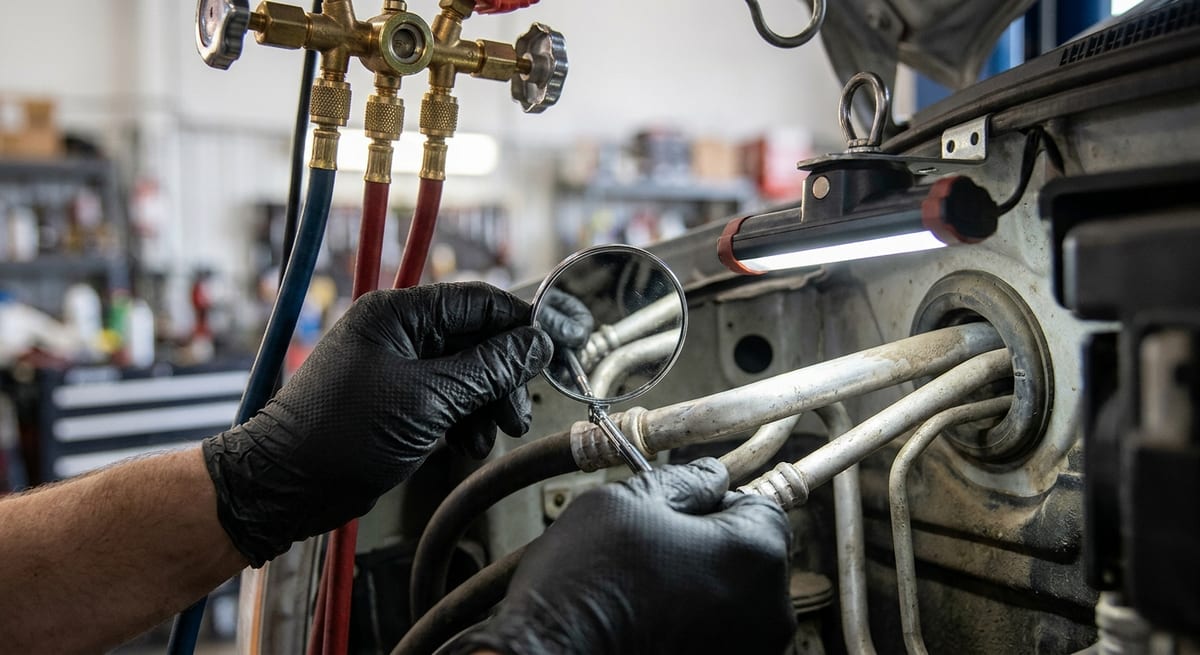
Start by recording when the problem happens. Does cooling fade after a long drive? Is airflow weak at every temperature setting? Does the coolant level fall between inspections? Specific observations are more useful than simply reporting that the HVAC system is not working.
The next checks should follow the truck manufacturer’s diagnostic procedure. Refrigerant leak testing and cooling-system pressure testing investigate different circuits; neither should be replaced by guesswork based on vent temperature alone.
Access time also varies considerably between trucks. Ask for an application-specific labour estimate instead of assuming every evaporator or heater core replacement requires the same amount of dashboard removal.
What to Check Before Ordering a Replacement
Once the faulty component is confirmed, collect these details:
- Truck identification: make, model, build date, and VIN.
- HVAC identification: housing label, assembly number, and cab or sleeper position.
- Part reference: the original number and any verified replacement or supersession.
- Physical specifications: core dimensions, overall size, tube layout, and mounting details.
- Connection details: refrigerant fittings and valve arrangement for an evaporator; coolant pipe configuration for a heater core.
- Package contents: whether seals, brackets, insulation, or other required items are included.
Even within a category such as Freightliner AC evaporators, confirm the individual listing against the installed unit.
Frequently Asked Questions
Can an evaporator and heater core be interchanged?
No. They handle different fluids and operate as parts of different circuits. Matching outer dimensions would not make them interchangeable.
Does a musty smell mean the evaporator is leaking?
No. Moisture and contamination around the HVAC system can create odours without a refrigerant leak. Drainage and filter condition should be investigated alongside the cooling complaint.
Should both cores be replaced while the housing is open?
Not automatically. Shared access can make inspection sensible, but the decision should reflect condition, test results, repair history, and the service procedure. Shared labour alone does not prove both components are faulty.
Can a heater control problem make the A/C seem weak?
Yes. If the system adds unwanted heat or directs air incorrectly, vent temperatures may remain too warm even when the refrigeration circuit is operating. That is why temperature-door operation belongs in the diagnosis.
The most useful distinction is simple: identify the circuit before choosing the component. Once testing confirms the fault, a part number and a careful connection check will prevent ordering mistakes better than a matching photograph. If a listing leaves those details unclear, contact Quick Fit Parts with the identification numbers and photos before purchasing.

Write A Comment