
A temperature gauge that creeps past its normal position is one of the warnings a driver should never ignore. Heat buildup in a heavy-duty diesel can warp cylinder heads, damage head gaskets, and leave a truck parked for days. The good news is that most semi-truck overheating issues come down to a short list of cooling-system parts, and you can often spot them with a careful inspection before replacing anything expensive.
This guide covers the nine most common reasons a semi-truck overheats, how to recognize each one, and what fixes it. In most cases, the problem sits somewhere between the coolant, the truck radiator, the charge air cooler, and the parts that move air and coolant through them.
What to Do When the Temperature Gauge Climbs
Acting quickly limits the damage. When the gauge rises above its normal range or a high coolant temperature warning comes on:
- Reduce the load on the engine. Ease off the throttle, drop a gear if you are climbing, and switch off the AC, which adds heat to the air flowing into the radiator.
- Turn the cab heater to full heat and full fan. The heater core works as a small extra radiator and pulls some heat out of the coolant.
- Pull over safely as soon as you can and follow the engine maker’s procedure for idling or shutting down.
- Never open the radiator cap or the reservoir tank cap while the system is hot. The coolant is under pressure and can spray out at boiling temperature. Let the engine cool completely first.
Many modern engines also protect themselves by reducing power or shutting down when coolant temperature gets too high. A derate is a warning, not a fix, so the cause still has to be found.

9 Causes of Semi Truck Overheating
1. Low Coolant Level or a Coolant Leak
Low coolant is the most common cause, and it is usually a symptom of a leak somewhere else. With less coolant in the system, there is less fluid to carry heat away from the engine, and air pockets can form around hot spots in the block and head.
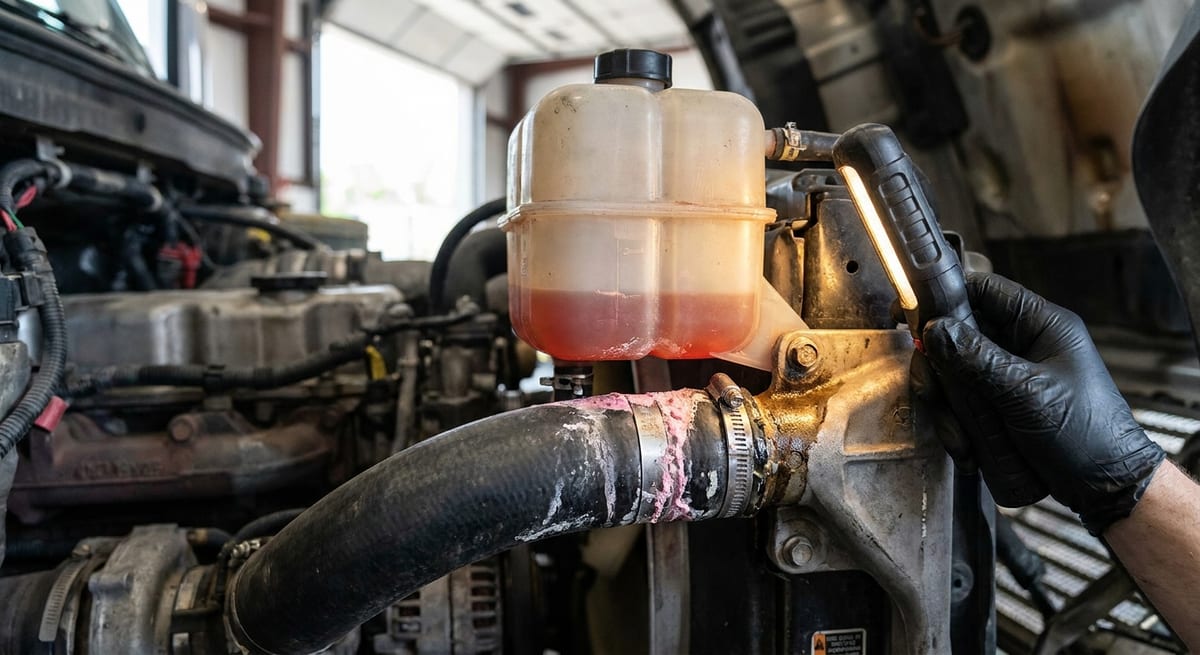
Check the level at the reservoir tank with the engine cold. Then look for the leak: wet spots or dried coolant crust on hoses and clamps, seepage at the radiator tanks and core, drips under the water pump, and coolant residue around the reservoir tank. If the level keeps dropping with no outside leak, coolant may be leaking internally, which needs a pressure test and a check for coolant in the oil.
2. A Blocked or Failing Truck Radiator
The radiator releases the engine’s heat into the air. When its tubes clog with scale, or its fins pack with dirt, bugs, and road debris, it cannot shed heat fast enough, especially under heavy load or in hot weather. Leaking tanks, cracked plastic necks, and corroded cores are other common failures on high-mileage trucks.
Signs that point to the radiator include cold spots across the core, bent or missing fins, visible leaks at the tank seams, and overheating that gets worse as the load increases. Our guide on how to diagnose and repair a truck radiator explains when a radiator can be repaired and when replacement makes more sense.
3. A Clogged Charge Air Cooler
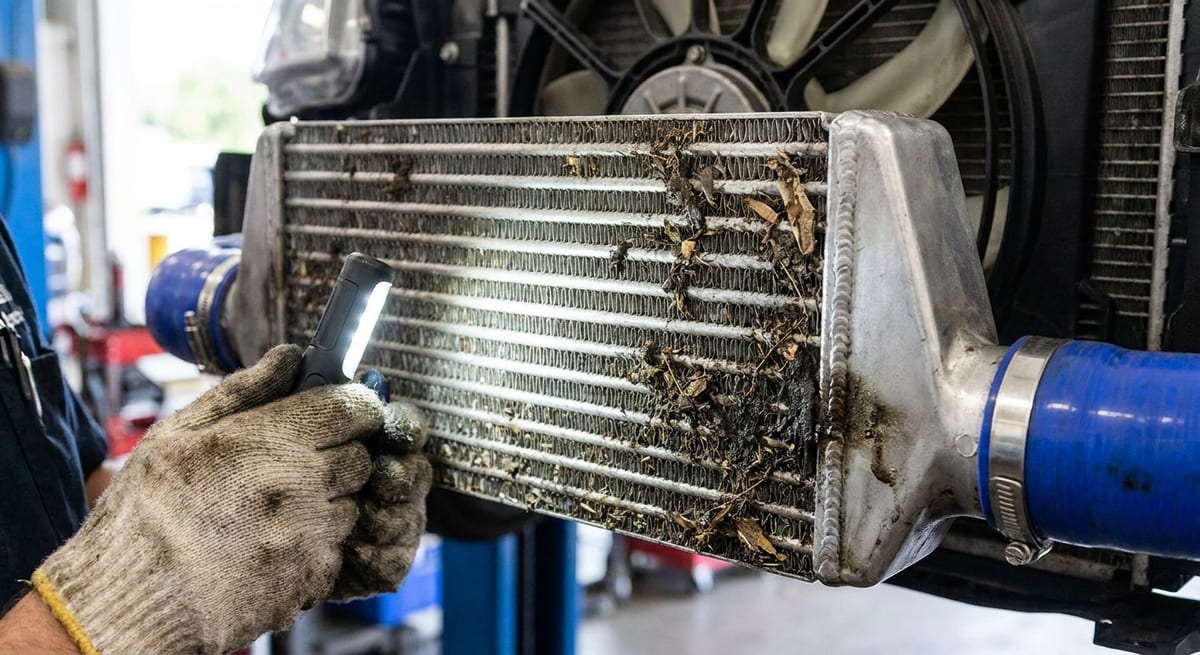
On a turbocharged diesel, the charge air cooler (CAC) usually sits in front of the radiator. Because the radiator breathes through the CAC, debris or oil-soaked dirt packed into the CAC fins starves the radiator of airflow. A leaking CAC also lets boost escape, so the engine works harder and runs hotter to make the same power.
Look for dirt packed between the fins, oily residue around the CAC tanks and boots, low power, and black smoke. For the full list of symptoms and how to leak-test the cooler, see signs of a failing charge air cooler. Replacement units are listed under truck charge air coolers.
4. A Thermostat Stuck Closed
The thermostat holds coolant inside the engine until it warms up, then opens to send it to the radiator. If it sticks closed, or only opens part of the way, hot coolant cannot reach the radiator even though the radiator itself is fine.
A typical sign is an engine that overheats quickly while the upper radiator hose stays cooler than expected. A thermostat that sticks open causes the opposite problem: an engine that runs cold and warms up slowly. Thermostats are inexpensive compared with the damage overheating can cause, so many shops replace them during any cooling system repair.
5. A Failing Water Pump
The water pump keeps coolant moving through the engine and radiator. A worn impeller, a failing bearing, or a leaking seal reduces flow, and heat builds up even when the coolant level is correct.
Watch for coolant seeping from the pump’s weep hole, a whining or grinding noise from the front of the engine, and play in the pump pulley. Because the pump is usually belt-driven, a slipping belt or a worn tensioner can also reduce flow, so check them at the same time.
6. A Fan Clutch or Cooling Fan That Won’t Engage
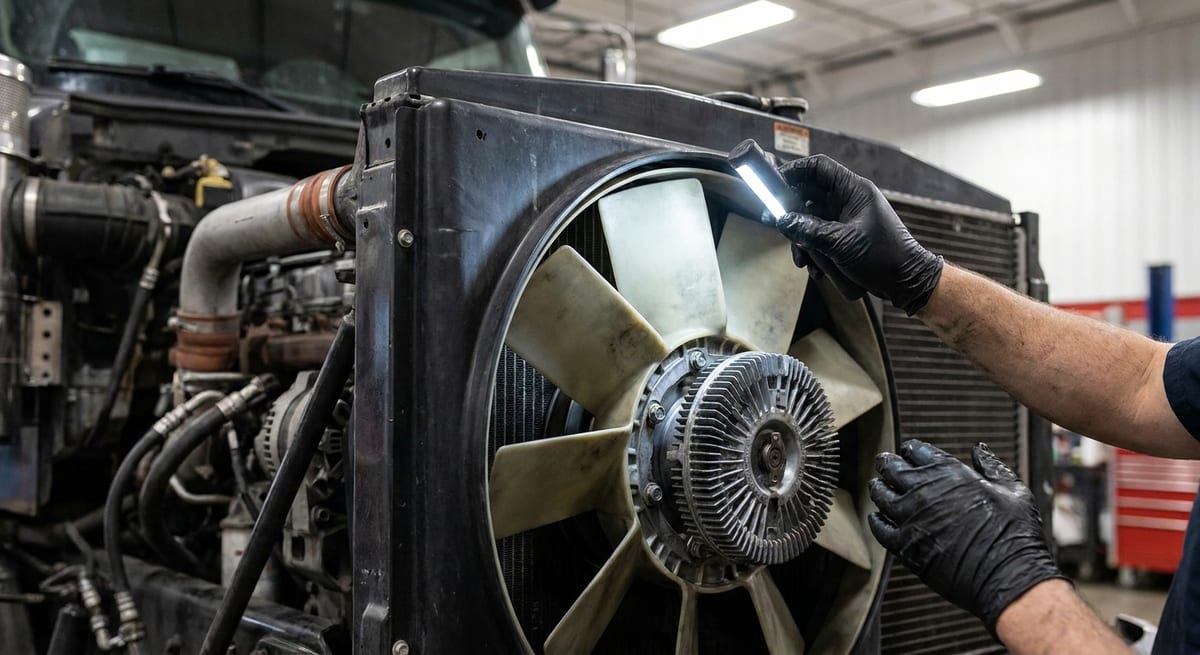
At highway speed, ram air does most of the cooling. At low speed and in traffic, the engine fan has to pull air through the cooling stack. Heavy-duty trucks commonly use a fan clutch that engages the fan only when cooling is needed. If the clutch fails to engage or slips, airflow drops just when the truck needs it most.
The classic sign is overheating at idle or in stop-and-go traffic that clears up once the truck is moving. On many trucks, the fan is also commanded on by high AC system pressure, so an AC that stops cooling at low speed can point to the same fan problem.
7. A Faulty Pressure Cap or Cracked Reservoir Tank
The cooling system is designed to run under pressure, because pressure raises the boiling point of the coolant. A cap with a weak spring or a damaged seal lets pressure escape, and the coolant can boil at a lower temperature. A cracked coolant reservoir tank causes the same loss of pressure and also leaks coolant.
A pressure test of both the system and the cap quickly shows whether either one is holding its rated pressure. Coolant residue around the tank, or a tank that loses level without a visible drip elsewhere, is a reason to inspect it closely.
8. Old or Incorrectly Mixed Coolant
Coolant wears out. As its additives break down, it protects less against corrosion and scale, and the deposits it leaves behind narrow radiator tubes and coat engine passages. Mixing different coolant types, or running too much or too little antifreeze in the water, also reduces its ability to carry heat.
Use the coolant type the engine maker specifies, follow its service interval, and test the coolant’s condition at each PM service rather than only topping it up. If the coolant looks rusty, oily or sludgy, the system needs a flush before the cause can be traced.
9. Debris Packed Between the AC Condenser, CAC and Radiator
On most heavy-duty trucks, the truck AC condenser, the charge air cooler, and the radiator sit stacked in front of the engine. Dirt, leaves, insects and road debris collect in the gaps between them, where they cannot be seen from the grille. Each layer of debris cuts the airflow that reaches the radiator at the back of the stack.
Clean the stack from the engine side out, using low-pressure air or water so the fins are not bent. Trucks that run on gravel, farm or construction sites usually need this done more often.
Overheating on the Highway vs. in Stop-and-Go Traffic
When the truck overheats tells you a lot about where to look:
| When it overheats | Most likely causes |
|---|---|
| In traffic or at idle, fine on the highway | Fan clutch or fan not engaging (cause 6), debris in the cooling stack (cause 9) |
| On the highway or under heavy load | Clogged radiator (cause 2), blocked or leaking CAC (cause 3), worn water pump (cause 5) |
| Soon after start-up, in any conditions | Thermostat stuck closed (cause 4), very low coolant (cause 1) |
| Gradually over weeks, with coolant loss | Leaks (cause 1), cracked reservoir tank or weak cap (cause 7) |
| After recent cooling system work | Air trapped in the system, wrong coolant mix (cause 8) |
How to Find the Root Cause, Step by Step
Working from the simplest checks to the more involved ones saves time and avoids replacing good parts:
- Check the coolant level and condition at the reservoir tank, with the engine cold.
- Look for leaks at hoses, clamps, radiator tanks, the water pump, and the reservoir tank.
- Inspect the cooling stack from both sides for packed debris, bent fins, and damage.
- Pressure-test the system and the cap to confirm both hold pressure.
- Watch the fan as the engine warms up to confirm the fan clutch engages.
- Feel or measure the hoses once the engine is warm. A cool upper hose on an overheating engine points to the thermostat.
- Check the belt and tensioner that drive the water pump and fan.
- Read the fault codes. Coolant temperature, fan, and boost codes help separate a cooling problem from a sensor problem.
- If nothing is found, have a shop check for combustion gases in the coolant, which points to a head gasket or internal leak.
Before You Order a Replacement Cooling System Part
Once the faulty part is confirmed, matching the replacement correctly matters as much as the repair itself:
- Match by OEM number stamped on the old part, and confirm the make, model, and year of the truck.
- Compare the dimensions: core height, core width, and depth for radiators, condensers, and charge air coolers, plus the size and position of every inlet and outlet.
- Inspect the neighbours in the stack. A radiator that failed from blocked airflow often sits behind a CAC or condenser that needs cleaning or replacing too.
- Decide between OEM and aftermarket based on fitment, construction, and warranty. Our comparison of OEM vs. aftermarket truck radiators covers the trade-offs.
Frequently Asked Questions
What is the most common cause of semi truck overheating?
Low coolant from a leak is the most common cause. Check the level at the reservoir tank with the engine cold, then look for the leak at hoses, clamps, the radiator, the water pump, and the tank.
Why does my semi truck overheat in traffic but not on the highway?
At highway speed, ram air cools the radiator. In traffic, the fan has to do that work, so a fan clutch that will not engage or a cooling stack packed with debris shows up at low speed first.
Can a charge air cooler cause overheating?
Yes. The CAC sits in front of the radiator, so debris in its fins blocks the radiator’s airflow, and a leaking CAC makes the engine work harder and run hotter.
Is it safe to open the radiator cap when the engine is hot?
No. The system is under pressure, and opening the radiator cap or the reservoir tank cap while hot can spray boiling coolant. Let the engine cool completely first.
Should I replace the thermostat when the truck overheats?
If the engine overheats quickly while the upper radiator hose stays cooler than expected, a thermostat stuck closed is the likely cause. Thermostats are inexpensive, so many shops replace them during any cooling system repair.
Can I keep driving a semi truck that is overheating?
Reduce the load, switch off the AC, turn the heater to full, and pull over safely as soon as you can. Continuing to drive with a high temperature reading risks serious engine damage.
Keep the Cooling Stack Doing Its Job
Most semi truck overheating causes are found in the same handful of places: the coolant, the radiator, the charge air cooler, the thermostat, the water pump, the fan, and the cap and reservoir tank. Checking them in order and cleaning the cooling stack regularly catches most problems before they turn into a breakdown. When a part does need replacing, match it by OEM number and dimensions in our truck radiator and charge air cooler ranges.
Write A Comment