
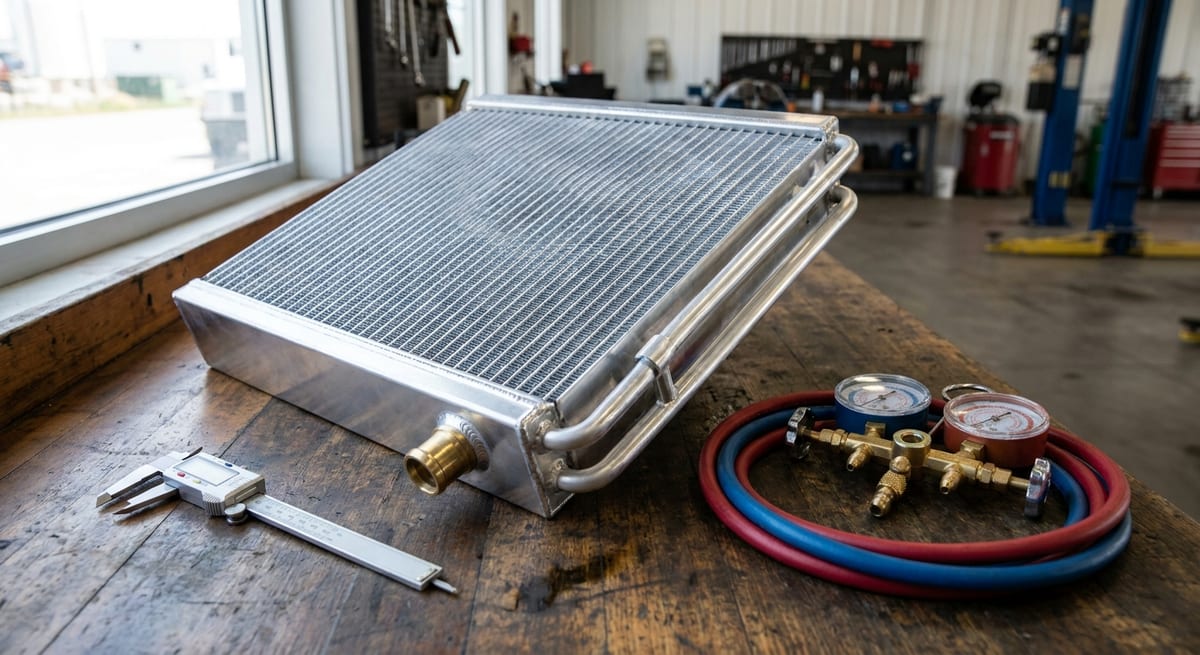
An evaporator that does not fit is an expensive mistake, and not because of the part price. By the time the wrong core comes out of the box, the dash is already apart, the system is already evacuated, and the truck is already not earning. On most heavy trucks, this job takes six to eight hours of labour, so a return means doing much of that work twice.
The frustrating part is that the wrong unit usually looks right. Two evaporators can share a core size, a shape, and a photo, then differ by a fitting size or a valve type that only shows up when a technician tries to connect the lines.
This guide explains what actually determines fitment on a truck AC evaporator, how to read a cross-reference list without getting misled, and why the VIN matters more than the model year when you order.
Related Reading: 8 Causes of a Semi Truck A/C Blowing Warm Air
Start With the Number on the Old Evaporator
The number stamped or labelled on the unit coming out is the most reliable starting point you have. It beats the model year, it beats a photo, and it beats a description over the phone.
Look on the end tank, the mounting flange, or a foil label on the side of the core. On older trucks, the label is often illegible after years of condensate and road film, so photograph it before cleaning anything, then clean carefully and photograph again.
If the number is gone, you are not stuck, but the order of operations changes. You will need the VIN, the measurements, and the fitting details covered below, and you should confirm all three rather than any one of them.
Why One Truck AC Evaporator Carries Six or Seven OEM Numbers
This is where most ordering errors start. A single evaporator can be listed under a long chain of numbers because the same core gets sold through the truck OEM, the component manufacturer, and several aftermarket brands, each with its own numbering system.
Take one Freightliner M2 Series evaporator covering roughly 2008 to 2017. It cross-references to seven numbers:
05-0621, PTAC6685, T1001848H, T3313, T6882, VCC T1001836U, VCCT1001836U
Look at the last two. They are the same number. The only difference is a space. This formatting split is extremely common across heavy truck catalogues, and it causes two opposite errors. Some buyers assume they are two different parts and keep searching for a variant that does not exist. Others search for one format, get no result, and conclude the supplier does not carry it.
The practical rule: strip spaces, dashes, and prefixes before deciding a number is not listed. Then search again.
There is a second pattern worth knowing. Certain prefixes, such as the Alliance ABP N83 307 series, appear across Volvo, Mack, Western Star, and Ford applications. That is not a catalogue error. It reflects one core being supplied to multiple truck builders, which is useful when the OEM number you have returns no result and the cross-reference does.
Evaporator Core Dimensions Are Not Overall Dimensions
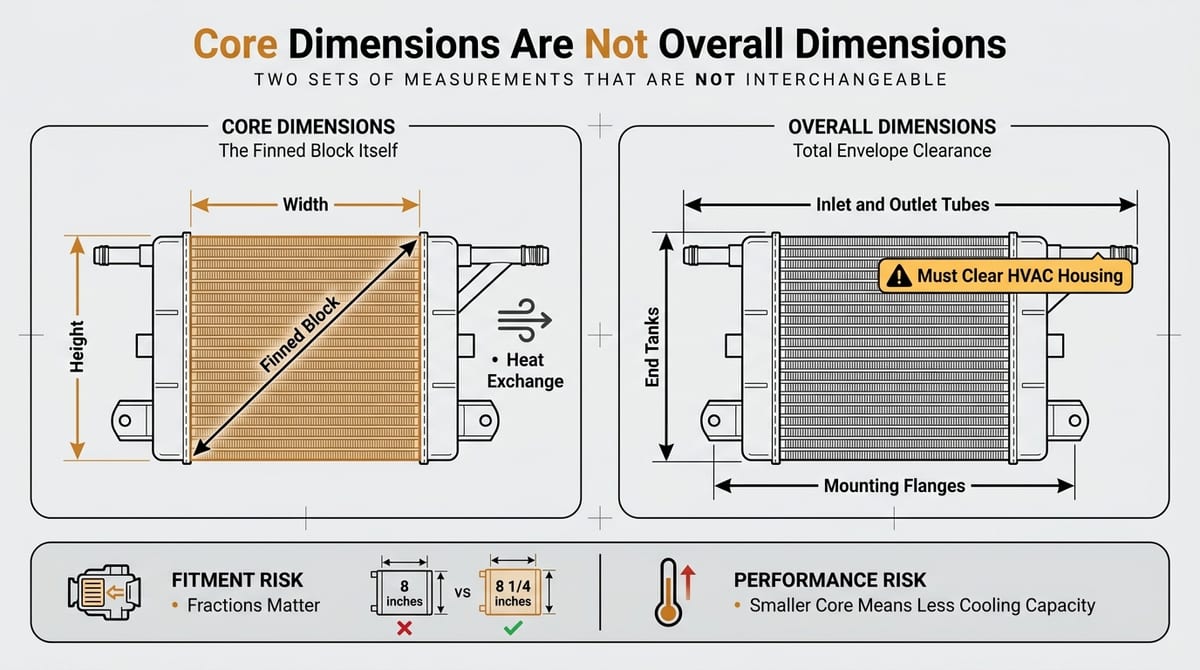
Evaporator listings carry two sets of measurements, and they are not interchangeable.
Core dimensions describe the finned block itself, the part that does the heat exchange. Overall dimensions include the end tanks, the inlet and outlet tubes, and anything protruding from the body.
A core that measures correctly can still fail to fit because the overall envelope has to clear the HVAC housing. The reverse happens too: an overall match with a smaller core means less cooling capacity than the truck was built with, and the driver will notice on the first hot day.
Fractions matter more here than anywhere else in the process. Core heights of 8 inches and 8 1/4 inches sit next to each other in most catalogues. On paper, that is a quarter inch. In a sealed HVAC box, it is the difference between a unit that seats and one that does not.
When measuring the old core, record core length, core height, and core width separately, and take the overall figures as well. Measure the metal, not the foam seal around it.
Valve Type: Block Valve, Expansion Valve, or Plain O-Ring Connection
This single specification causes more returned semi-truck AC evaporator orders than anything else, and it is the easiest to miss because many listings bury it.
Heavy truck evaporators are generally built for one of three arrangements. A block valve unit has a flat mating face where a block-style thermal expansion valve bolts directly to the evaporator. A unit specified for a separate AC expansion valve connects through lines instead. A plain O-ring style connects directly without an integrated valve mounting face.
The important part is that the same truck model can appear with more than one arrangement. Sleeper and day cab builds of the same Cascadia year can take different evaporators, with some variants listed for expansion valve applications only. The model name alone does not settle it.
If you are replacing a valve at the same time, confirm the evaporator and the valve are specified for each other before either one ships.
Inlet and Outlet Fittings and the AC Lines That Meet Them
A common assumption is that both ports on an evaporator share a fitting type and size. On heavy trucks, they frequently do not.
Three fitting styles dominate: Springlock, beaded, and threaded male O-ring. Port sizes are given as dash numbers, usually #8, #10, or #12.
Real examples make the point. One Ford/Sterling application runs a #8 Springlock inlet with a #10 Springlock outlet, so the style matches but the size does not. Another runs a #8 Springlock inlet with a #12 threaded O-ring outlet, so neither matches. Both are factory configurations.
Record the inlet and the outlet as separate specifications every time, noting style and size for each. While the system is open, plan on new O-rings for every joint disturbed, and inspect the AC lines where they meet the evaporator, since those connections are a common secondary leak found mid-job.
The Model Year Will Not Tell You Enough. The VIN Will
Model year tells you roughly when the truck was built and sold. The VIN tells you how it was built, and HVAC specification is a build decision.
Two trucks of the same model year can carry different evaporators depending on sleeper or day cab configuration, destination market, and whether the build fell before or after a mid-cycle change.
The clearest example on the road today is the Cascadia. The HVAC housing design changed substantially with the generation introduced in 2018, and components are not interchangeable across that line. A buyer working from the model year alone, with a truck built close to the changeover, has a genuine chance of ordering a part that cannot physically mount.
Mid-year production changes exist on other platforms too, which is why listings often show a production year range rather than a single year. When your truck sits near either end of a listed range, verify by VIN rather than assuming.
Add the AC Drier and Seals to the Same Order
Any time the system comes open, the AC drier is replaced. The desiccant absorbs atmospheric moisture quickly once exposed, and a saturated drier will shorten the life of the evaporator you just installed.
Add the O-rings for every connection you will break, and confirm the refrigerant type and oil specification on the under-hood label before recharge.
Related Reading: What Else to Replace With an AC Compressor on a Truck
Confirm the Truck AC Evaporator in Hand Before the Dash Comes Apart
Sequence saves more money here than any single specification.
Verify the evaporator is genuinely the failure before ordering, since several faults produce the same warm air complaint. Order against the old number, the VIN, and the measurements together rather than any one of them. Then, with the new unit physically in hand, compare the core dimensions, the valve mounting face, and both fittings against the old part before a single dash fastener comes out.
Five minutes of comparison on a bench prevents a truck sitting apart for a week waiting on a second shipment.
Quick Fit Parts lists evaporators by truck make for Volvo, Kenworth, Peterbilt, International, and Freightliner, with OEM cross-references and production year ranges on each listing.
Frequently Asked Questions
Can I use an evaporator from a different truck make if the numbers cross-reference?
Often yes. Shared cores supplied to several truck builders are common, and that is exactly what a cross-reference list documents. Confirm that core dimensions, valve type, and both fitting specifications match before ordering.
What if the part number on my old evaporator is unreadable?
Work from the VIN and physical measurements together. Record core and overall dimensions, the valve mounting arrangement, and the style and dash size of the inlet and outlet separately, then verify against the listing before purchase.
Does a longer cross-reference list mean a better part?
No. List length reflects how many brands have catalogued that core, not its quality. Judge the part by construction and fitment accuracy.
Why do two listings for my truck show different evaporators?
Build variation. Sleeper and day cab configurations, mid-year production changes, and destination market can all change the specified evaporator within one model year. The VIN resolves it.
Should I replace the expansion valve with the evaporator?
If the valve is the block type mounted to the evaporator, or if contamination caused the original failure, replace both. A new evaporator installed behind a restricted valve will not cool correctly.
How do I know the new evaporator will not leak at the fittings?
Fit new O-rings on every joint, torque to specification rather than by feel, and pressure test before recharging. Reusing hardened O-rings is a frequent cause of repeat leaks on otherwise correct installations.

Write A Comment