
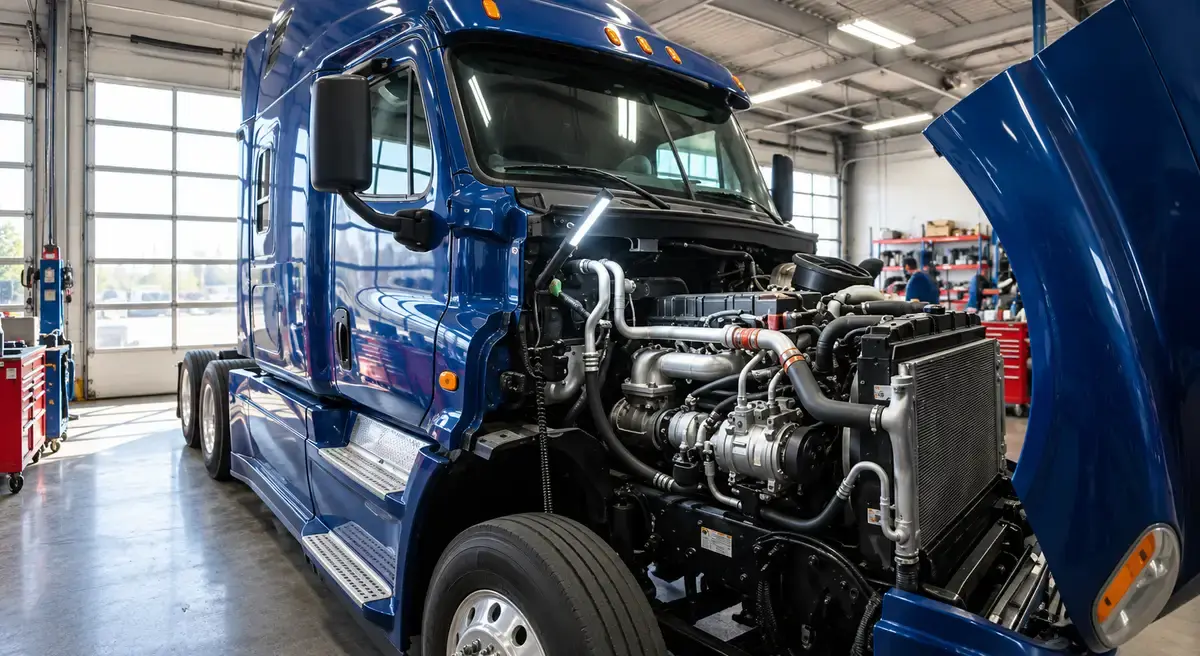
A truck A/C system rarely quits all at once. Most drivers notice it over a few days. The vent air is not quite as cold as last week, then it only cools at highway speed, then one afternoon it stops cooling altogether.
The system itself is not complicated. Refrigerant gets compressed, cooled, dried, metered through a restriction, and allowed to expand inside the cab where it absorbs heat. When warm air comes out of the vents, one of those steps has stopped working, and there are only a handful of places it can go wrong.
This guide covers the eight causes behind almost every warm-air complaint on a heavy truck, what each one looks like from the driver’s seat, and how to tell them apart before you spend money on parts.
Truck AC Blowing Warm Air: Start by Narrowing It Down
Three different complaints get described as “the A/C is not working,” and they point in different directions.
No cold air at all. The compressor clutch is probably not engaging, or the system has lost most of its charge. Start with Causes 1, 2, and 7.
Cooling that has faded over weeks or months. Think slow leak, or a condenser that has lost its ability to shed heat. Start with Causes 1 and 3.
Cold on the highway, warm at idle or in slow traffic. Airflow across the condenser is the first suspect, since road speed is doing work the fan should be doing. Go to Cause 3.
Air that starts cold and turns warm after twenty minutes. Look at Cause 6. That pattern points at a freezing evaporator more often than anything else.
Knowing which of these you have removes half the list before you open the hood.
Related Reading : 5 Signs Your Semi Truck A/C Condenser Is Failing
Cause 1. Low Refrigerant Charge or a Leak in the System
This is the most common reason a truck A/C blows warm. Refrigerant is not consumed the way oil or coolant is. The system is sealed, so if the charge is low, it leaked out, and adding more without finding the leak just buys you a few weeks.
Lose enough of the charge and the low-pressure cutout opens, so the compressor clutch stops engaging at all. Lose a smaller amount, and the compressor keeps running, but there is not enough refrigerant moving through the evaporator to pull much heat out of the cab. Vent temperature climbs, and the system struggles hardest on the hottest days, which is exactly when the driver notices.
On a heavy truck, the charge tends to escape at the hose crimps, the O-ring joints at every connection, the service port valves, or the condenser itself after a stone strike. Confirm the leak with UV dye or an electronic detector instead of guessing. If the system has been open to atmosphere for any length of time, plan on replacing the AC drier at the same time.
Cause 2. A Failing Truck AC Compressor
The compressor is the pump. When it wears internally, it still turns, still makes noise, and still looks fine from outside, but it no longer builds the pressure difference the system needs.
Watch for a system that holds a correct charge and still will not cool, with gauge readings sitting too close together. A worn compressor cannot pull the low side down or push the high side up. You may also hear a rattle or growl that changes with engine speed, or notice the clutch cycling far more often than it used to.
A compressor that has seized or come apart internally is a different situation entirely. Metal debris travels through the whole system, and replacing the truck AC compressor on its own will destroy the new unit within weeks. That kind of failure means flushing the lines, replacing the drier and the expansion valve, and recharging with the correct volume of compressor oil.
Skipping those steps is the single most expensive shortcut in truck A/C work.
Cause 3. A Blocked or Damaged AC Condenser
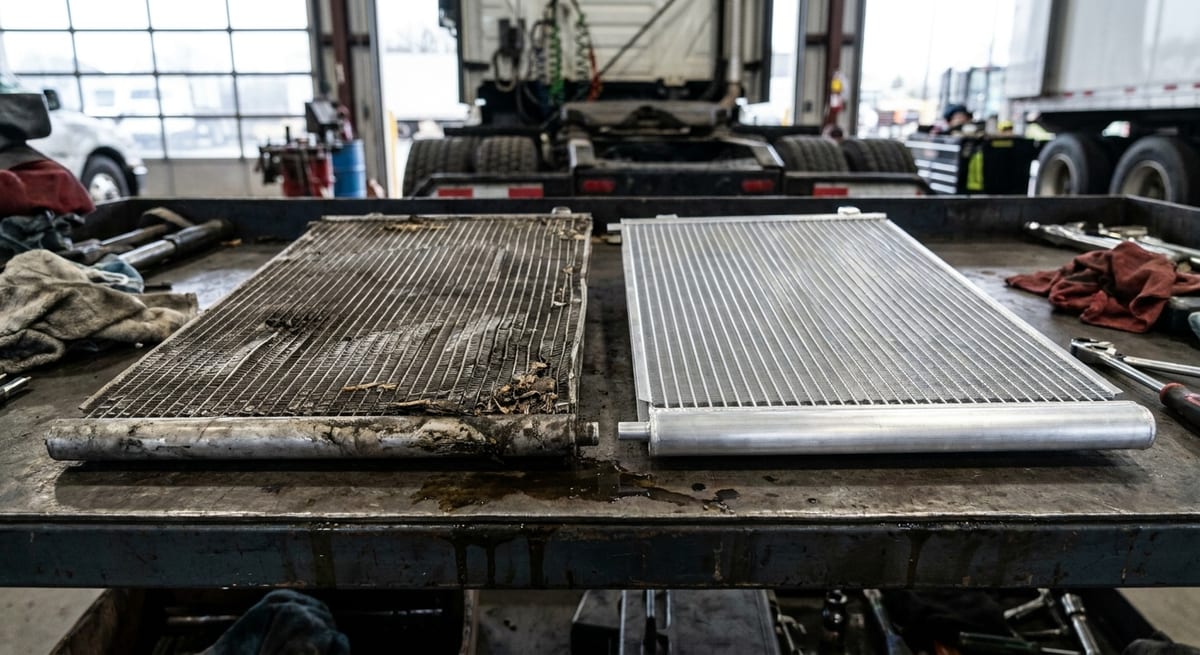
The condenser sits at the front of the truck and dumps heat out of the refrigerant. It lives in the worst possible spot for bugs, road salt, gravel, and oil film, and it loses performance gradually as the fins load up.
The tell is cooling that depends on road speed. At 100 km/h there is enough air moving through the core to do the job, so the cab stays comfortable. Pull into a yard or sit in stopped traffic and the vent temperature climbs within a few minutes, because now the system is relying on the fan alone.
Sometimes a wash and a careful pass with a fin comb bring it back. Sometimes the core is bent, corroded, or leaking and needs replacing. We covered how to tell the difference, including what to look for around the core and when cleaning is no longer worth doing, in 5 Signs Your Semi Truck A/C Condenser Is Failing. If the condenser turns out to be your problem, that article will take you further than this one. Replacement AC condensers are listed by truck make.
Cause 4. A Saturated or Clogged AC Receiver Drier
The drier has two jobs. It holds a desiccant that pulls moisture out of the refrigerant, and it traps debris before any of it reaches the expansion valve.
Desiccant has a finite capacity. Once it is saturated, moisture circulates freely, and moisture in a refrigerant system does real damage. It forms acid, corrodes aluminum from the inside, and can freeze at the expansion valve and block flow intermittently. A truck that cools fine some days and not others, with no other pattern to it, is often carrying a saturated drier.
A drier can also plug with debris, most often after a compressor has shed material. That creates a restriction, and you will feel it as a cold line going into the drier and a noticeably cooler or frosted line coming out.
The AC drier is one of the cheapest parts in the system, and it should be replaced any time the system is opened. That rule holds even when the drier is not the fault you are chasing.
Related Reading : How to Repair a Truck Radiator: Diagnose, Fix, or Replace
Cause 5. A Stuck AC Expansion Valve
The expansion valve meters refrigerant into the evaporator. It is the point where high-pressure liquid becomes low-pressure vapour, and it is where most of the actual cooling happens.
A valve stuck closed starves the evaporator. The low side drops very low, sometimes into vacuum, the high side climbs, and almost no cold air reaches the cab. A valve stuck open floods the evaporator instead. Now the low side runs high, the high side runs low, the air comes out cool rather than cold, and liquid refrigerant can make it back to the compressor, which is hard on it.
Both failures produce warm air, so the gauges are what separate them. Debris and moisture are what cause most of these failures, which ties this part straight back to the drier. When an AC expansion valve fails because of contamination, replacing the valve without replacing the drier puts the new valve into the same conditions that killed the old one.
Cause 6. A Frozen or Restricted AC Evaporator
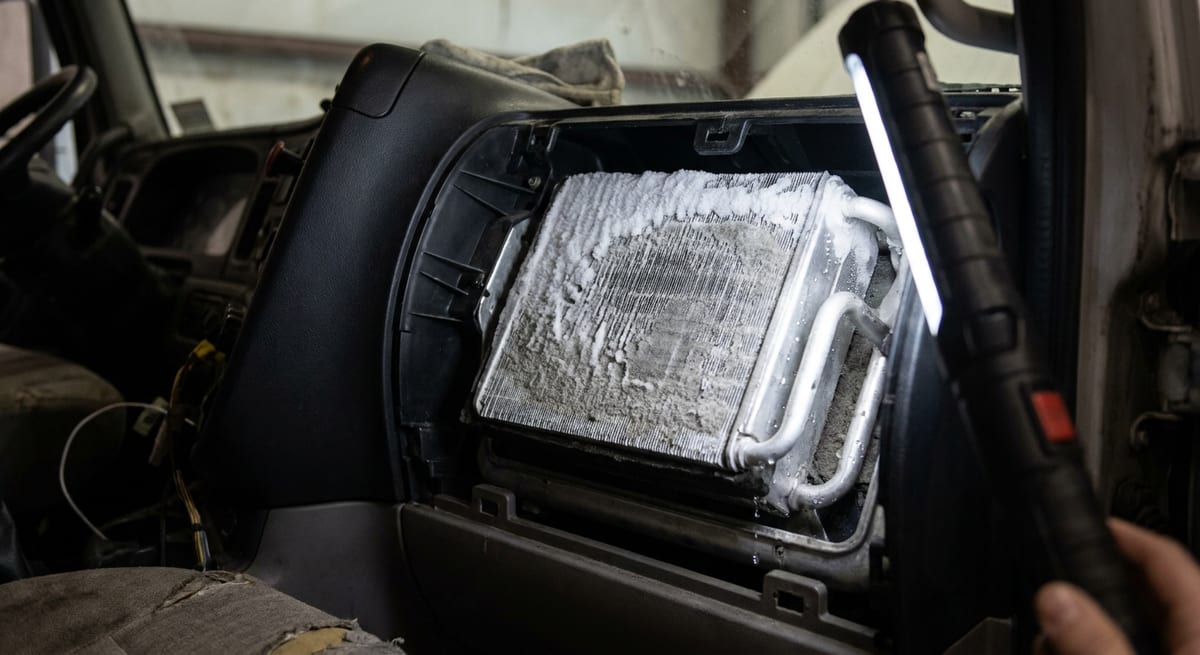
The evaporator is the heat exchanger inside the dash. Because of where it sits, it is the hardest part of the system to inspect and the one that gets misdiagnosed most often.
What gives it away is timing. The air blows cold for the first twenty minutes or so, then goes warm while the blower keeps running at the same speed. Ice has built up on the evaporator fins and is now blocking airflow through the core. Shut the system off for a while, and the cooling comes back, then disappears again on the same schedule.
Freezing is rarely a fault in the evaporator itself. It follows a low charge, a stuck expansion valve, or a failed cycling switch, so treat it as a symptom and keep looking.
An evaporator can also leak, and because the leak is inside the dash, the refrigerant simply disappears with nothing visible under the truck. A sweet smell at the vents, oily residue in the condensate drain, or a system that keeps losing charge with no leak found anywhere else all point to the AC evaporator.
Cause 7. A Faulty AC Pressure Switch
If the compressor clutch never engages and the refrigerant charge is good, check the pressure switch before condemning anything expensive.
The switch is a protective device. It reads system pressure and cuts power to the clutch when pressure falls too low or climbs too high, which keeps the compressor from running without lubrication or against a blockage. When the switch itself fails, it can hold that circuit open permanently, and the compressor never gets the signal to engage even though nothing else in the system is wrong.
Testing it is straightforward. Confirm the charge is correct, then check for voltage at the clutch with the A/C switched on. Good charge and no voltage puts the fault in the control circuit, and a truck AC switch is a much cheaper place to start than a compressor. Switches are specific to the truck make, so confirm the part by model rather than by appearance, because several of them look nearly identical.
Cause 8. A Leaking AC Line or Failed O-Ring
Lines and seals are the quiet cause. Nothing looks broken, nothing makes noise, and the system just loses its charge over a season.
The failure points are consistent. O-rings harden with age and heat and stop sealing, particularly at the compressor and condenser connections. Hose crimps work loose after years of vibration. Rubber sections chafe where they pass close to the frame or a bracket. Service port valves seep, and so do the caps that are supposed to back them up. Barrier hose permeates slowly over a long enough period too, which is normal on a truck that has been in service fifteen years.
Look for oily residue. Escaping refrigerant carries oil with it; the oil stays behind, and it collects dirt, so any dark, damp-looking ring around a fitting deserves a closer look. When a line gets replaced, every O-ring that was disturbed should be replaced with a new one. AC lines and O-rings are both listed by application.
Related Reading : 7 Warning Signs of a Failing Charge Air Cooler
How to Narrow It Down in 10 Minutes
A manifold gauge set turns this from guesswork into a short process. Connect it, run the engine at roughly 1,500 rpm with the A/C on maximum and the doors open, and let the readings settle for several minutes.
Exact numbers shift with ambient temperature and humidity, so treat these as patterns rather than targets and compare them against the specification for the system in front of you.
Low on Both Sides
The charge is low. Something is leaking, and finding it matters more than topping up. See Causes 1 and 8.
High Low Side, Low High Side
The compressor is not building pressure, or an expansion valve is stuck open. Two pressures drifting toward each other is the signature of a pump that has stopped pumping. See Causes 2 and 5.
High on Both Sides
Heat is not leaving the system. Either the condenser cannot shed it, or the system is overcharged. Check airflow and fan operation before anything else. See Cause 3.
Low Low Side, High High Side
Something is restricting flow between the two, most often the expansion valve or a plugged drier. Run your hand along the lines and feel for a sudden temperature change, which normally sits right at the restriction. See Causes 4 and 5.
What to Check Before You Order Replacement AC Parts
Heavy truck A/C parts are make- and model-specific, and a condenser that fits one Cascadia will not necessarily fit the next one off the line. Before ordering:
- Find the part number on the old component, usually stamped into the body or printed on a label
- Have the VIN handy, since it confirms the build specification rather than the model year alone
- Check fitting sizes and orientation, not just overall dimensions
- Confirm whether your truck uses an expansion valve or an orifice tube, because the two are not interchangeable
- Order the drier and the O-rings along with the main component, since both need replacing once the system is open
- Check the oil type and volume the compressor calls for before recharging
Quick Fit Parts lists cooling and A/C components by truck make, and the VIN search will match parts to your specific build. Same-day pickup and fast delivery are available on stocked items, which counts for something when the truck is sitting.
Frequently Asked Questions
Why does my truck AC only blow cold when I am driving?
Airflow across the condenser is the usual answer. At road speed, there is enough air moving through the core to shed heat, but at idle the system depends on the fan. Check the condenser fins for blockage and confirm the fan is engaging properly.
Can I just add refrigerant to fix warm air?
Adding refrigerant may restore cooling for a short time, but a sealed system does not consume refrigerant. If the charge is low, it leaked, and it will leak again. Overcharging brings its own problems as well, including high head pressure and poor cooling.
Why is my AC compressor not turning on?
The common reasons are a low refrigerant charge triggering the low-pressure cutout, a failed pressure switch, or an electrical fault in the clutch circuit. Confirm the charge first, then check for voltage at the clutch.
Do I need to replace the receiver drier every time?
Yes, any time the system has been opened to atmosphere. The desiccant absorbs moisture from the air quickly, and a saturated drier puts that moisture back into the system and shortens the life of whatever you just replaced.
How cold should the air from a truck AC be?
On a hot day, vent temperature should sit well below ambient, typically around 40 to 50 degrees Fahrenheit, or 4 to 10 degrees Celsius, at the centre vent with the system on maximum. Air that is only a few degrees cooler than outside means the system is not performing.
What causes a truck AC evaporator to freeze?
Freezing is a symptom rather than a cause. A low refrigerant charge, a stuck expansion valve, or a failed cycling switch can all let the evaporator drop below freezing, at which point ice blocks airflow through the core and the air turns warm.
Should I replace the compressor or the condenser first?
Diagnose before replacing either one, since both are expensive and both produce similar symptoms. The gauges will separate them. A compressor that cannot build pressure shows the two readings drifting together, while a restricted condenser shows high pressure on both sides.
Can I recharge a truck AC myself?
Not legally in Ontario, and not safely either. Leak testing has to be done by someone holding an Ozone Depletion Prevention certificate, using equipment that captures the refrigerant rather than releasing it. Discharging any refrigerant into the environment is illegal, whether it is ozone-depleting or not. The rules also require that a leak be repaired before the system is refilled, which lines up with the advice in Cause 1: topping up a leaking system is a temporary fix at best.
What happens if I keep driving with a low refrigerant charge?
You risk the compressor. Refrigerant carries the oil that lubricates it, so a low charge means less oil circulating, more heat, and more wear on a part that is expensive to replace. The low-pressure cutout exists to prevent exactly this, but a marginal charge can sit just above the cutout point and run the compressor dry for weeks. Fix the leak rather than living with it.
How long should a truck AC compressor last?
There is no fixed number, because duty cycle matters more than age. A truck that idles with the A/C running for long stretches puts far more hours on the compressor than one doing highway work. What shortens compressor life predictably is running with a low charge, debris left in the system after an earlier failure, and skipping the drier on a previous repair. Compressors that are kept properly charged and get a new drier at every service tend to go a long time.
What refrigerant do heavy trucks use?
Most heavy trucks on the road use R134a. Some newer builds use R1234yf, and the two are not interchangeable. The fittings differ, the oil requirements differ, and mixing them contaminates the system. Check the under-hood label before servicing anything.
Why does my truck AC smell musty when I first turn it on?
That smell usually comes from the evaporator. The core stays damp from condensate, and in a cab that sits for long periods, growth builds up on the fins. Running the fan with the A/C off for a few minutes before shutting down helps dry the core. A smell that will not clear, combined with poor airflow, can mean the evaporator itself needs attention.

Write A Comment