
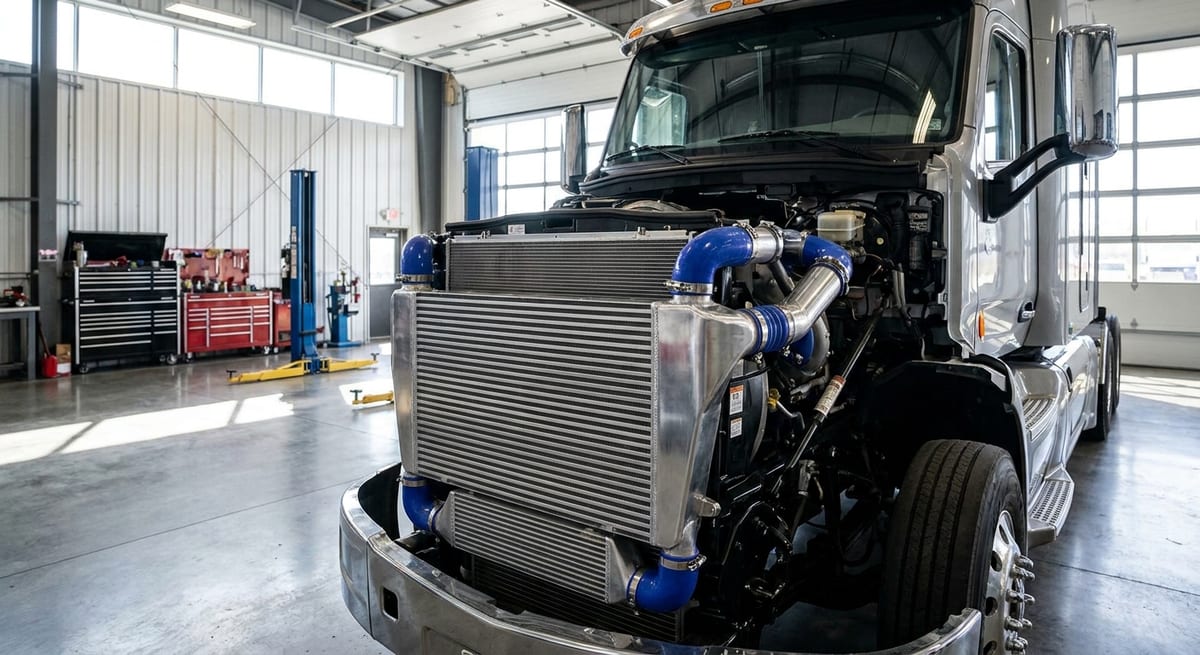
If your truck feels weaker than usual, uses more fuel, or makes a hissing sound when you accelerate, the problem may not be the turbocharger itself.
It could be the charge air cooler.
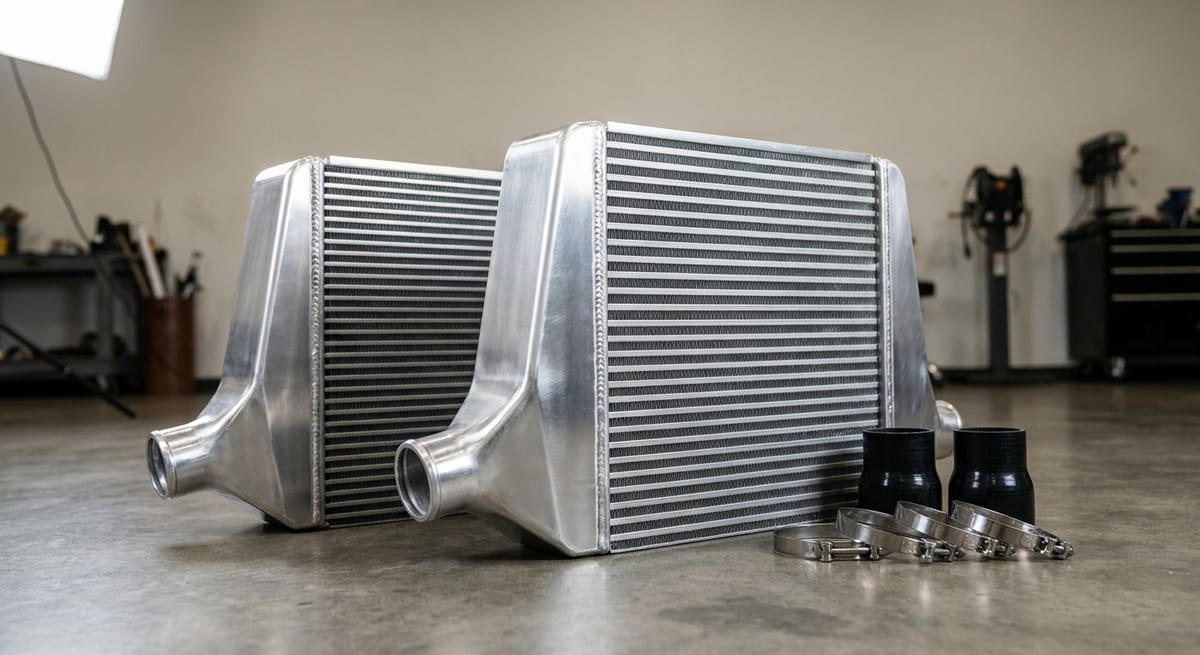
Also known as an intercooler or CAC, the charge air cooler cools the compressed air coming from the turbocharger before it enters the engine. When the system is working properly, that cooled, denser air supports efficient combustion and consistent engine performance.
When the charge air cooler develops a leak or becomes damaged, things can start to feel a little off. You may notice reduced pulling power, poor fuel economy, low-boost warnings, or an unusual hissing sound under load.
The tricky part is that these symptoms do not always mean the CAC itself has failed. A damaged charge air hose, worn boot, loose clamp, or another issue in the boost system can produce very similar symptoms.
So before replacing anything, it helps to know what to look for.
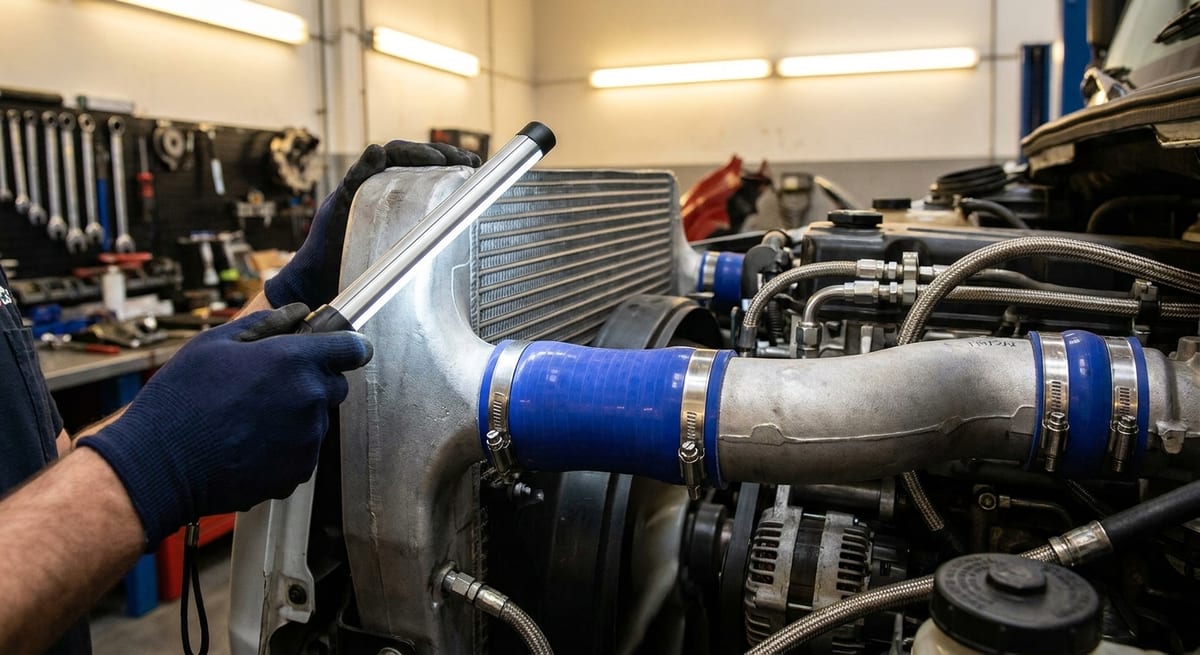
How to Tell If a Charge Air Cooler Is Bad
A failing charge air cooler does not always cause an immediate breakdown. In many cases, a small leak gradually becomes more noticeable as the truck operates under heavier loads and higher boost pressure.
Here are seven common warning signs to watch for.
1. Your Truck Has Lost Power
One of the most common signs of a charge air leak is reduced engine power.
Your truck may feel slower when accelerating, struggle to maintain speed on a grade, or require more throttle than usual when hauling a heavy load.
If pressurized air escapes before it reaches the intake, the engine is not receiving the amount of boost it expects. The result can be noticeably weaker performance, especially when the engine is working hard.
However, do not assume that power loss automatically means the charge air cooler is bad. The turbocharger, charge air pipes, boots, clamps, and other intake components should also be inspected.
For example, if you are troubleshooting a Freightliner application, inspect the complete system before replacing one of the Freightliner charge air coolers.
2. You Hear a Hissing or Whistling Sound Under Acceleration
A noticeable hissing or whistling sound under boost can be another sign that pressurized air is escaping from the system.
You may hear it when accelerating, climbing a hill, or pulling a heavy load.
The source could be:
- A cracked charge air cooler
- A leaking CAC seam
- A damaged charge air hose
- A split or loose boot
- A loose clamp
- A damaged pipe connection
That is why it is important to inspect the entire charge air system rather than replacing the cooler based on the sound alone.
A pressure test can help identify exactly where the air is escaping.
3. Your Truck Is Using More Fuel Than Usual
If your routes, loads, and operating conditions have stayed fairly consistent but your fuel consumption has increased, a charge air leak may be worth investigating.
A leak can reduce the amount of pressurized air reaching the engine and affect overall combustion efficiency. When this happens alongside reduced power or a noticeable hissing sound, the charge air system deserves a closer look.
The same applies across different heavy-duty applications. For example, if a Volvo truck is showing unexplained power loss and declining fuel economy, inspect the CAC and related components before replacing parts. You can also browse available Volvo charge air coolers when a replacement has been confirmed.
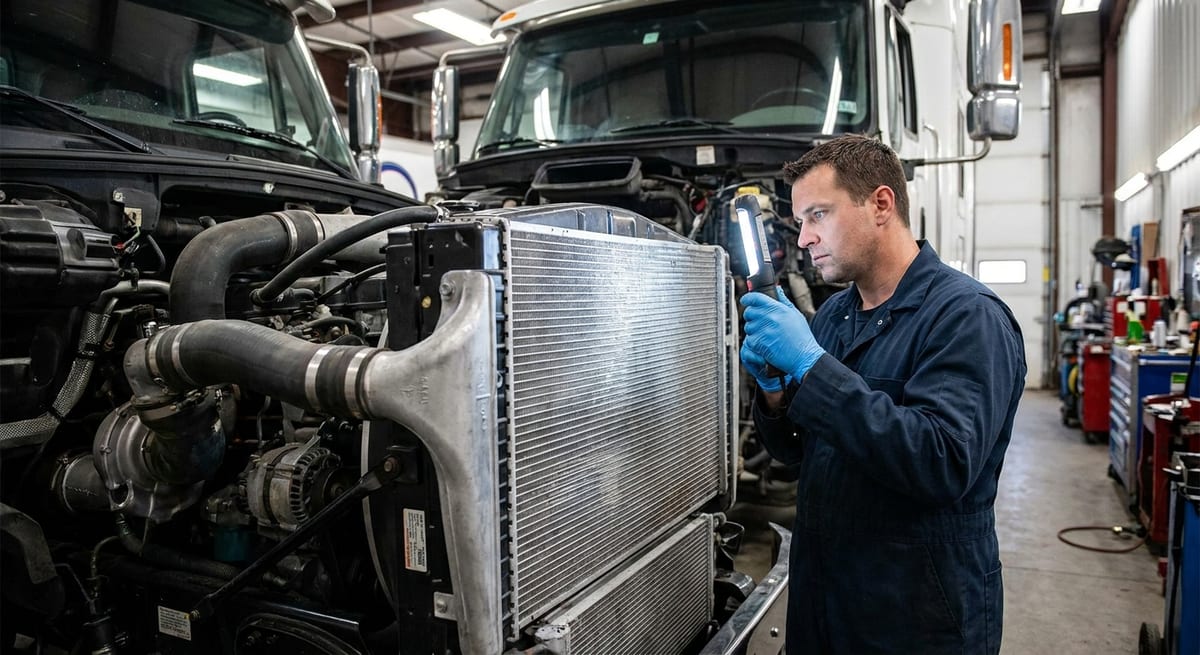
Related Reading: Is the Problem in the Cooling System?
Not every performance issue comes from the charge air cooler. If your truck is running hot or showing signs of a cooling-system problem, read How to Repair a Truck Radiator: A Practical Guide to understand what could be causing the issue before replacing major components.
4. You Notice More Black Exhaust Smoke
Black exhaust smoke can indicate that the engine is not receiving the right amount of air for efficient combustion.
A significant leak in the charge air system can reduce the amount of pressurized air reaching the engine, which may contribute to darker exhaust smoke, particularly during acceleration or under heavy load.
That said, smoke alone is not enough to diagnose a failing charge air cooler.
Turbocharger problems, fuel system issues, and other engine faults can cause similar symptoms. Treat smoke as one clue rather than proof that the CAC needs to be replaced.
5. You Find Oil Residue Around the Charge Air System
Oil residue around a connection can help point you towards a possible leak.
Depending on the engine, a light film of oil inside the charge air system may not be unusual. However, heavy oily buildup around a CAC seam, hose connection, boot, or pipe can indicate an area that needs closer inspection.
Check around:
- CAC end tanks
- Core seams
- Charge air hoses
- Rubber boots
- Clamps
- Pipe connections
- Turbo outlet connections
Oil and dirt often collect around an area where pressurized air is escaping. If one section of the system has noticeably more buildup than the rest, inspect it carefully.
If you are working on an International truck, check the full charge air path before ordering a replacement International charge air cooler.
6. You Have a Low-Boost Warning or Related Fault Code
A significant charge air leak may trigger a check engine light or a boost-related fault code.
For example, an underboost condition can occur when the system cannot maintain the expected pressure.
However, the fault code does not automatically identify the failed component.
Possible causes may include:
- A leaking charge air cooler
- A damaged hose
- A loose or failed clamp
- A leaking boot
- A damaged charge air pipe
- A turbocharger problem
- Another intake or air-system fault
The code gives you a starting point. It does not replace a proper inspection or pressure test.
7. You Can See Physical Damage
Sometimes the problem is visible before you even start testing.
Inspect the charge air cooler for:
- Cracked end tanks
- Damaged seams
- Bent or crushed areas
- Corrosion
- Damage caused by road debris
- Damaged mounting points
- Heavy dirt or debris restricting airflow
Heavy-duty trucks are exposed to constant vibration, road debris, moisture, and repeated temperature changes. Over time, these conditions can contribute to wear or damage.
Canadian winter conditions can add another challenge. Road salt, slush, moisture, and freeze-thaw cycles can all be hard on exposed components.
If the CAC is visibly cracked or damaged, it should be properly tested before you order a replacement.
What Causes a Charge Air Cooler to Fail?
A charge air cooler operates under demanding conditions. It deals with pressurized air, heat, vibration, and constant exposure to road conditions.
Several factors can contribute to failure.
Repeated Heat Cycles
The CAC repeatedly heats up and cools down during normal operation.
Over time, this expansion and contraction can place stress on the core, seams, joints, and end tanks. Eventually, that stress may contribute to cracking or separation.
Constant Vibration
Heavy-duty trucks experience vibration every day, particularly when operating under heavy loads or on rough roads.
Over time, vibration can place additional stress on the charge air cooler, mounting points, hoses, and connections.
A loose or damaged mounting point can make the problem worse.
Road Debris and Physical Damage
Rocks and other road debris can damage the cooler or surrounding components.
A direct impact may cause immediate damage, while smaller impacts can gradually weaken the core or surrounding areas.
The front-mounted position of many CACs can leave them exposed to debris coming from the road.
Corrosion and Environmental Exposure
Moisture, road salt, and other contaminants can contribute to corrosion over time.
This is particularly relevant for trucks operating through Canadian winters, where components may be regularly exposed to salt and slush.
Corrosion can weaken the affected areas and eventually contribute to leaks or structural damage.
Excessive Pressure or Problems Elsewhere in the System
A charge air cooler does not operate on its own.
Problems involving the turbocharger or other parts of the boost system can affect operating conditions throughout the system. If there is an underlying issue, replacing the CAC without identifying the root cause may not solve the problem.
That is why a complete inspection is important before installing a replacement.
How to Test a Charge Air Cooler for Leaks
A visual inspection is a good starting point, but it will not always reveal a small crack or pressure leak.
A pressure or leak-down test is one of the most reliable ways to determine whether the charge air system is holding pressure within the manufacturer’s specifications.
Before testing, inspect the complete system, including:
- The charge air cooler
- Charge air pipes
- Hoses
- Boots
- Clamps
- Connections
The test pressure and acceptable pressure loss can vary by engine and manufacturer. For many heavy-duty applications, a test is performed around 30 psi, but the pass/fail specification should always come from the applicable engine or vehicle manufacturer.
During testing, the system is pressurized and monitored for pressure loss. A soapy water solution can then be applied around seams and connections to help locate escaping air.
If bubbles appear around a hose connection, clamp, or boot, the CAC itself may not be the problem.
If the leak is confirmed through the CAC core or seam, replacement may be necessary.
Always release pressure safely and follow the manufacturer’s testing procedure. If you do not have the proper equipment or experience, have the system inspected by a qualified heavy-duty truck technician.
How to Tell Whether the Problem Is the CAC, a Hose, or a Clamp
Before ordering a replacement, try to narrow down where the problem is actually coming from.
If You Hear Hissing Under Acceleration
Inspect the charge air hoses, boots, clamps, and connections first.
A loose clamp or split boot can create a major boost leak and produce symptoms that feel very similar to a failed CAC.
If You Find Oil and Dirt Around One Connection
Look closely at that specific area.
Oil residue combined with accumulated dirt can sometimes help identify where pressurized air has been escaping.
If There Is a Visible Crack in the CAC
A visible crack is a serious warning sign, but testing can still help confirm the severity and location of the leak.
Do not assume that every damaged-looking area is the only problem. Check the complete system.
If You Have a Low-Boost Fault
Test the charge air system before replacing the turbocharger or CAC.
An underboost code can be caused by a leak anywhere downstream in the boost system.
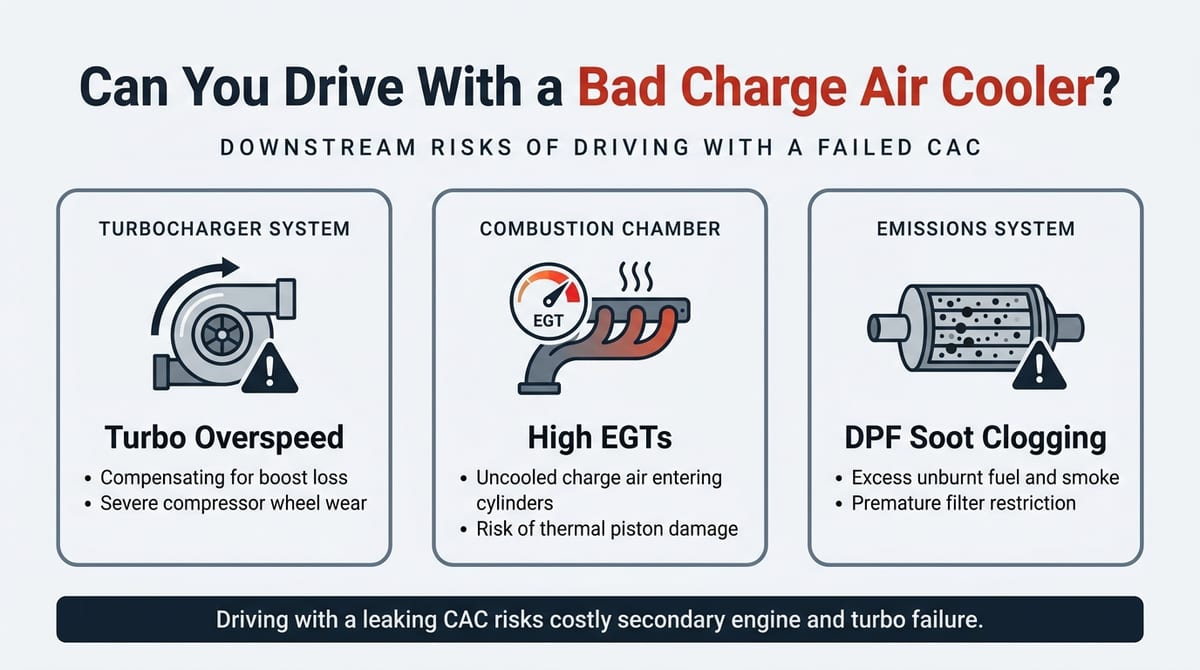
Can You Drive With a Bad Charge Air Cooler?
It depends on how severe the problem is, but a significant CAC leak should not be ignored.
A damaged or leaking charge air cooler can lead to:
- Reduced engine power
- Poorer fuel economy
- Reduced performance under load
- Boost-related fault codes
- Increased soot production
- More frequent regeneration events on some diesel applications
- Additional strain on related components
A small leak may become worse as the truck continues to operate under boost pressure.
If your truck suddenly loses power, develops a loud air leak, produces unusual exhaust smoke, or repeatedly triggers low-boost warnings, have the system inspected before the problem leads to unexpected downtime.
Before You Replace Your Charge Air Cooler
If testing confirms that the CAC itself is leaking or damaged, the next step is finding the correct replacement.
Before ordering, check:
- Part number or OEM cross-reference
- Core dimensions
- Inlet and outlet configuration
- Mounting points
- Truck make
- Engine and application compatibility
Quick Fit Parts offers a selection of truck charge air coolers for heavy-duty truck applications.
You can also browse available charge air coolers by truck make:
Always match the replacement to your truck’s specific application rather than choosing a charge air cooler based only on appearance.
Find the Right Charge Air Cooler for Your Truck
Think your charge air cooler is failing?
Start by checking the complete charge air system and carrying out a proper pressure test.
If the test confirms that the CAC itself is leaking or damaged, browse our selection of truck charge air coolers and choose a replacement that matches your truck’s application.
Frequently Asked Questions About Charge Air Cooler Problems
How do I know if my charge air cooler is leaking?
Common signs include reduced engine power, slower acceleration, a hissing sound under boost, increased fuel consumption, low-boost fault codes, and oily residue around CAC seams or connections.
However, these symptoms can also be caused by a leaking hose, damaged boot, or loose clamp. A pressure or leak-down test is the best way to determine whether the leak is actually coming from the CAC.
Can a small charge air cooler leak cause a noticeable loss of power?
Yes. Even a relatively small leak can affect boost pressure, particularly when the engine is operating under heavy load.
The symptoms may be more noticeable when climbing grades, accelerating, or hauling heavy loads because the system is operating at higher pressure.
The size of the leak alone does not tell you how much it will affect performance. Its location, the engine’s operating conditions, and the amount of pressure loss all matter.
Will a bad charge air cooler always trigger a check engine light?
No. A minor leak may not immediately trigger a fault code. In some cases, the first signs are reduced pulling power, poorer fuel economy, or a hissing sound under acceleration.
A larger leak is more likely to create an underboost condition that the engine management system can detect.
Can I pressure-test the CAC without removing it from the truck?
In many applications, the charge air system can be tested while installed using the correct adapters and test equipment.
However, the procedure depends on the truck and engine configuration. The system should be tested according to the applicable manufacturer specifications, including the correct test pressure and acceptable pressure decay.
Do not exceed the recommended pressure for your specific application.
How can I tell the difference between a bad turbo and a charge air cooler leak?
The symptoms can overlap.
Both problems may cause reduced power, poor acceleration, and boost-related fault codes. A CAC or charge air system leak may also create a noticeable hissing sound and leave oily residue around a leaking connection.
Before replacing a turbocharger, test the complete charge air system. Confirming that the system holds pressure can help rule out leaks downstream of the turbo.
Can a damaged charge air cooler affect fuel economy?
Yes. A leak that reduces the amount of compressed air reaching the engine can affect combustion efficiency and may contribute to increased fuel consumption.
If fuel economy has dropped without a clear change in routes, load, or operating conditions, inspect the charge air system along with other possible causes.
Should I replace the charge air cooler if I find oil inside it?
Not necessarily.
A light oil film inside parts of a turbocharged diesel intake system may be normal depending on the engine. Heavy oil accumulation, however, can indicate another issue, such as excessive oil entering the intake system.
Before replacing the CAC, identify where the oil is coming from and inspect the turbocharger and related components if necessary.
Can a damaged CAC be repaired instead of replaced?
That depends on the type and location of the damage, but a field repair is not always a reliable long-term solution for a pressurized charge air cooler.
If a pressure test confirms that the core or seam is leaking beyond the manufacturer’s allowable limit, replacement is generally the safer option. Follow the applicable manufacturer recommendations for your specific CAC and application.
Final Thoughts
A failing charge air cooler can be easy to overlook at first. Your truck may simply feel slower, use more fuel, or make an unusual hissing sound when accelerating. But when several of these symptoms appear together, the charge air system deserves attention.
Start with a visual inspection of the CAC, hoses, boots, clamps, pipes, and connections. If the signs point to a boost leak, carry out a proper pressure test to identify where the air is escaping.
Do not replace parts based on guesswork. A loose clamp or damaged hose does not necessarily mean you need a new charge air cooler. But if testing confirms that the CAC itself is cracked, leaking, or damaged, choosing the correct replacement can help restore proper airflow and reduce the risk of unnecessary downtime.

Write A Comment