

When a semi-truck A/C system starts blowing warmer than usual, the compressor often gets blamed first. But the compressor is only one part of the system. A damaged, leaking, or restricted condenser can create many of the same symptoms.
That matters on a working truck. A cab that cools reasonably well on the highway but struggles while idling in Mississauga traffic, sitting on the 401, or waiting at a yard may be giving you an early warning that heat is not being removed properly from the A/C system.
A semi-truck A/C condenser works as a heat exchanger. Hot, high-pressure refrigerant leaving the compressor passes through the condenser, where airflow carries heat away and allows the refrigerant to continue through the cooling cycle. Restricted airflow, physical damage, corrosion, or a refrigerant leak can reduce that heat transfer and eventually leave you with warm air in the cab.
Here are five signs worth checking before replacing the compressor or simply adding more refrigerant.
1. The Air Is Cool, but Not as Cold as It Used to Be
Reduced cooling is one of the first symptoms drivers tend to notice.
The A/C may still work, but the vent temperature does not drop as quickly as it used to, or the cab never quite gets comfortable on a hot afternoon.
A condenser problem is one possible cause. If the condenser cannot release enough heat, the refrigerant entering the rest of the system may not be in the condition the A/C system expects.
But warm air alone does not confirm a bad condenser.
Low refrigerant charge, a refrigerant leak elsewhere in the system, compressor problems, a restricted expansion valve, heater-control issues, evaporator problems, or an airflow fault can produce similar symptoms.
For example, if you’re working on a Freightliner Cascadia and have already ruled out refrigerant charge and compressor issues, checking the condenser for leakage, fin damage, and airflow restriction is a sensible next step. If replacement is required, compare the existing unit carefully with the available Freightliner A/C condensers before ordering.
2. Cooling Gets Noticeably Worse at Idle or in Slow Traffic
Pay attention to when the cooling problem happens.
If the A/C feels reasonably cold while the truck is moving but starts warming up during extended idle or slow traffic, condenser airflow deserves a closer look.
At road speed, air naturally moves through the front cooling stack. At low speed, the system depends much more heavily on the truck’s fan and the ability of air to pass through the condenser fins.
A condenser packed with bugs, dirt, road debris, or damaged fins may still remove enough heat at highway speed but struggle when airflow drops.
For trucks working throughout the GTA, this can become especially noticeable during summer stop-and-go traffic.
Owners of Kenworth T680 and similar highway tractors should also inspect the entire front cooling stack rather than looking only at the condenser face. Dirt trapped between the condenser and other heat exchangers can restrict airflow even when the front surface does not look heavily blocked.
If a damaged unit needs replacement, the correct Kenworth A/C condenser should be matched using the truck’s year, model, fittings, and part reference.
3. You Can See Damage, Corrosion, or Blocked Fins
The front of a Class 8 truck takes a beating.
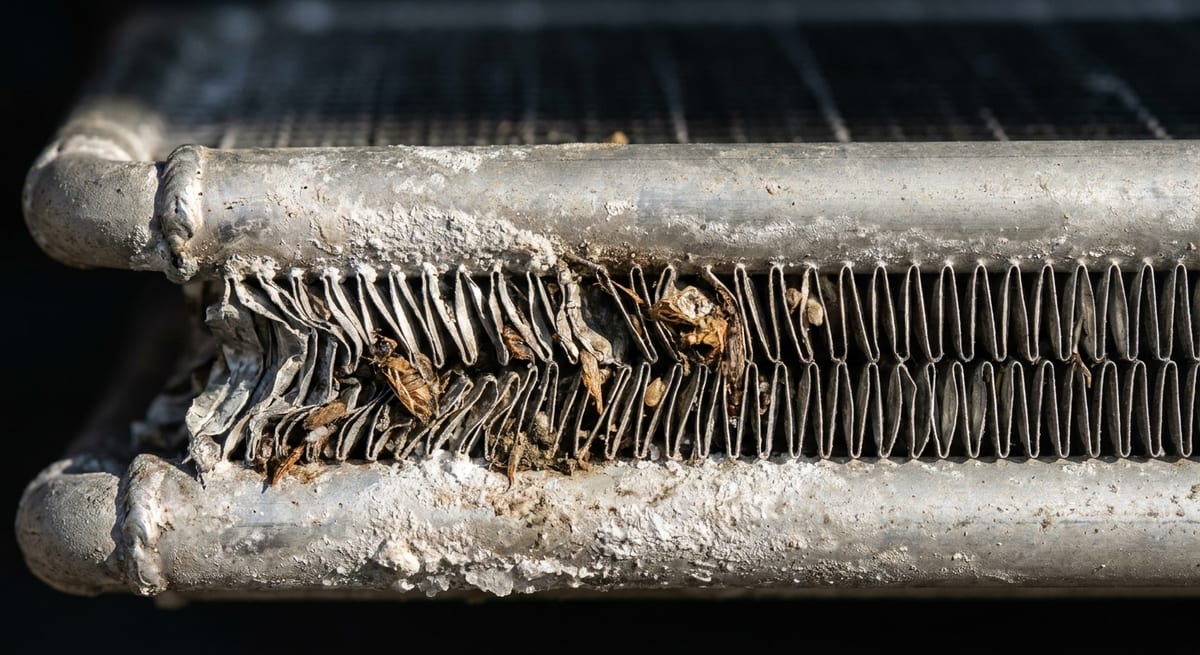
Gravel, insects, road debris, moisture, salt, and winter slush all reach the cooling stack. Over time, condenser fins can become bent, corroded, or packed with debris.
A few bent fins do not automatically mean the condenser needs replacement. What matters is whether the damage is restricting airflow, affecting the tubes, or creating a refrigerant leak.
Look through the grille and inspect the visible portion of the condenser for crushed areas, heavy debris buildup, damaged tubes, corrosion around seams and fittings, or sections of fins that have folded over.
Canadian winters make this inspection particularly worthwhile. Repeated exposure to road salt and moisture can accelerate corrosion on exposed cooling-system components.
This is particularly relevant on trucks that spend years running Ontario and Quebec winter routes. Peterbilt applications, like any other highway tractor, can develop corrosion or physical damage depending on service conditions. When replacement is necessary, use the existing part number and connection layout to identify the correct Peterbilt A/C condenser.
If the core is simply dirty, careful cleaning may restore airflow. If tubes are punctured, fittings are damaged, or the core is badly corroded, replacement becomes more likely.
4. There Is Oily or Greasy Residue Around the Core
Refrigerant oil circulates through the A/C system with the refrigerant.
When a small refrigerant leak develops at a condenser tube, fitting, joint, or damaged section of the core, some oil may escape with it. Dust and road grime then stick to the area, leaving a dark or greasy patch.
That makes oily residue a useful clue, but not a diagnosis by itself.
Oil can come from nearby components, and very small refrigerant leaks may leave little visible evidence. A shop may use electronic leak detection, UV dye where appropriate, or another approved leak-testing method to confirm the source.
This matters on Volvo VNL applications where several A/C components and lines are located close enough that the source of an oily area should be confirmed before a condenser is ordered. If testing points directly to the condenser, the truck’s model year and existing part reference can then be matched against the available Volvo A/C condensers.
If the system repeatedly loses refrigerant after being recharged, simply topping it up is not the answer. The leak needs to be located and repaired.
5. System Pressure Is Abnormal or the Compressor Keeps Cutting Out
A restricted condenser can cause high discharge pressure because the system is struggling to get rid of heat.
Depending on the truck’s HVAC controls, excessive or insufficient refrigerant pressure may cause a pressure switch or control system to disengage the compressor to protect the A/C components.
To the driver, this may feel like cooling that repeatedly comes and goes.
But frequent compressor cycling is not automatically a condenser failure.
Other causes can include low refrigerant charge, a leak, pressure-switch problems, thermostat or control issues, electrical faults, refrigerant overcharge, or restrictions elsewhere in the system.
On Mack trucks, for example, the correct diagnosis should still come before parts replacement. If testing confirms the condenser is restricted or leaking, compare the original component against the available Mack A/C condenser options rather than choosing one based only on truck make.
In other words, connect the gauges before connecting the symptoms to a replacement part.
If you’re diagnosing other cooling or airflow problems on the same truck, these guides may also help:
Condenser Problem or Compressor Problem?
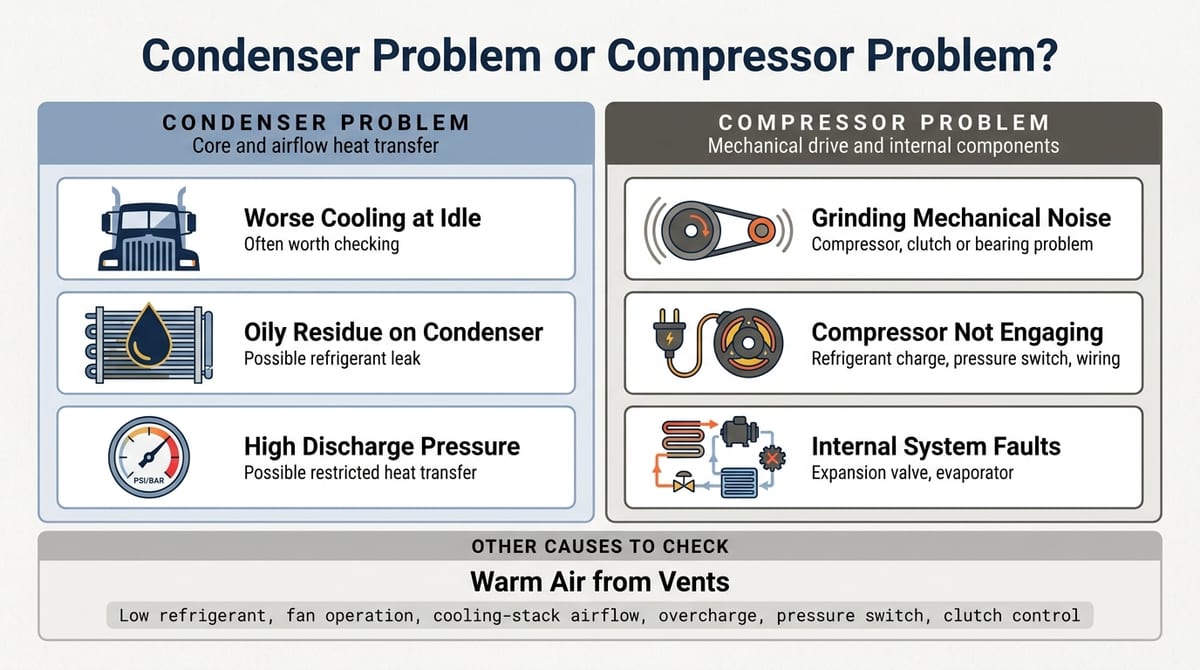
These two failures can feel similar from the driver’s seat.
What you notice | Condenser may be involved | Other causes to check |
|---|---|---|
Warm air from vents | Yes | Low refrigerant, compressor, expansion valve, evaporator |
Worse cooling at idle | Often worth checking | Fan operation, cooling-stack airflow |
Oily residue on condenser | Possible refrigerant leak | Confirm exact leak location |
High discharge pressure | Possible restricted heat transfer | Overcharge, airflow problem, other restrictions |
Compressor not engaging | Not enough evidence | Refrigerant charge, pressure switch, wiring, clutch/control system |
Grinding or mechanical noise at compressor | Less likely to be condenser itself | Compressor, clutch or bearing problem |
The important point is that a semi-truck A/C condenser should not be replaced simply because the cab is warm. The full system needs to be considered.
What Usually Causes a Truck Condenser to Fail?
Physical exposure is one of the condenser’s biggest disadvantages.
Its position in the cooling stack leaves it exposed to debris and contamination that other A/C components do not experience to the same degree.
Road debris can damage tubes or fins. Salt and moisture can contribute to corrosion. Dirt and insects can restrict airflow. Constant truck vibration can stress mounting points and connections.
There is also another failure scenario that needs special attention: compressor contamination.
If a compressor fails internally and sends metal or other debris through the refrigerant circuit, the technician needs to determine which components can be cleaned and which need replacement. The correct procedure depends on the A/C system design and the extent of contamination.
For International trucks, this is also a good point to verify the condenser using the OEM or cross-reference number before ordering. Quick Fit Parts lists International A/C condensers by application, which can help narrow the search once the failed part has been identified.
Replacing a condenser without addressing the original cause can result in another A/C failure.
Should You Clean the Condenser or Replace It?
It depends on what has failed.
If cooling performance is being affected by dirt or debris blocking airflow, cleaning the external surface may help. Bent fins can sometimes be carefully straightened if the tubes themselves are undamaged.
A leaking or physically damaged core is different.
If the condenser has a confirmed refrigerant leak, damaged tubes, severe corrosion, or an internal restriction that cannot be properly corrected, replacement is usually the sensible repair.
Whenever the refrigerant system is opened, moisture control becomes important. The receiver-drier or accumulator should be handled according to the service procedure for that system, and new O-rings or seals specified for the repair should be used rather than reusing old seals.
Finding the Right Semi-Truck A/C Condenser
Fitment matters as much as the diagnosis.
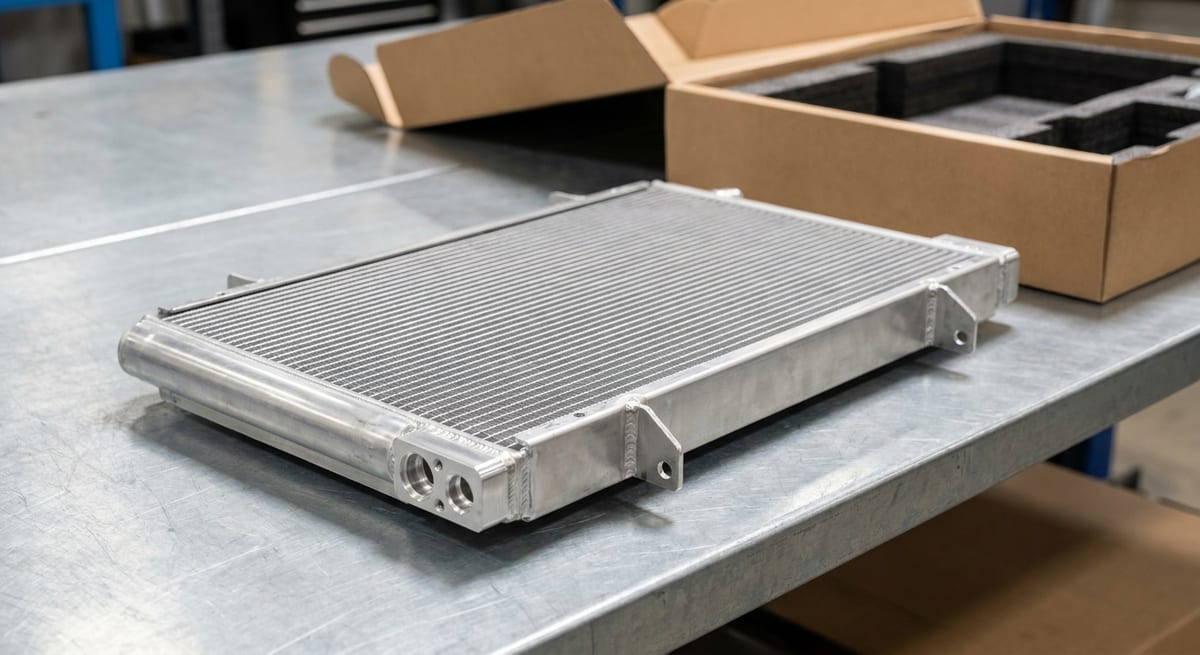
Two trucks carrying the same badge may use different condenser configurations depending on model year, engine package, HVAC configuration, fittings, mounting points, or production changes.
Before ordering, compare:
Truck make
Model
Model year
OEM or cross-reference number
Core dimensions when required
Connection locations
Mounting configuration
Quick Fit Parts carries semi-truck A/C condensers and other heavy-duty HVAC components for common Class 8 applications.
If you’re repairing a Western Star, for example, checking the existing condenser against the available Western Star A/C condensers is more useful than ordering a generic unit based only on truck make.
The same rule applies across brands: identify the failure first, then confirm the replacement part against the truck and the component being removed.
How Much Does It Cost to Replace an A/C Condenser in a Semi Truck?
There is no useful single price for every truck.
The condenser itself varies by make and application, while the final shop bill can also include labour, refrigerant recovery, new seals, a receiver-drier, evacuation, leak testing, and refrigerant recharge.
Access also matters. A condenser that is straightforward to remove on one truck may require more disassembly on another.
For that reason, the most accurate estimate starts with the truck’s make, model, year, and condenser part number rather than a generic labour-time figure.
What to Check Before Ordering a Replacement
Before buying a new condenser:
Confirm the actual cause of the A/C complaint.
Check the condenser for debris and damage.
Inspect for signs of refrigerant leakage.
Verify fan and airflow operation.
Measure system pressures using the applicable service procedure.
Confirm the replacement using the OEM/reference number and physical configuration.
This avoids one of the most expensive mistakes in A/C work: replacing a good component while the actual fault remains somewhere else in the system.
Related Reading
If you’re diagnosing other cooling or airflow problems on the same truck, these guides may also help:
Frequently Asked Questions
What is the most common part to fail on an A/C condenser?
A condenser does not usually have one separate moving part that fails first. In truck applications, the more common problems involve damage to the core or tubes, refrigerant leaks, corrosion, bent or blocked fins, and damage caused by road debris or vibration.
How do I know if my semi-truck A/C condenser needs to be replaced?
A condenser may need replacement when inspection and testing confirm a refrigerant leak from the core, serious physical damage, severe corrosion, or an internal restriction that cannot be corrected.
Weak cooling, poor performance at idle, abnormal pressure readings, oily residue, and compressor cycling can point technicians toward the condenser, but none of those symptoms alone proves it has failed.
What happens when an A/C condenser fails?
If airflow is restricted, the condenser may not reject enough heat and discharge pressure can rise. If the condenser leaks, refrigerant charge gradually drops and cooling performance deteriorates.
Eventually, the cab may stop cooling properly and other A/C components can be placed under unnecessary stress.
How much does it cost to replace an A/C condenser in a truck?
Cost depends on the truck, condenser design, labour required, refrigerant type and quantity, and any related components that need replacement.
The job may also require a receiver-drier and seals, along with refrigerant recovery, evacuation, leak testing, and recharge. A quote based on the specific truck and part application is more useful than a generic replacement price.
Can you drive a semi truck with a bad A/C condenser?
If the problem is limited to the cab A/C system, the truck may remain mechanically operable, but that does not mean the issue should be ignored.
A/C also helps with windshield dehumidification, and some condenser airflow problems can involve the rest of the front cooling stack. If the truck is also running hotter than normal or showing another cooling-system problem, it should be inspected.
Should the receiver-drier be replaced when the condenser is replaced?
In systems that use a receiver-drier, it is commonly replaced when the refrigerant circuit has been opened because the desiccant can absorb moisture. Follow the service procedure for the specific truck and A/C configuration.

Write A Comment