
Order the wrong one and nothing fits, which is the good outcome. The bad outcome is a system that goes back together, runs for a season, and takes the compressor with it. Both parts hold a desiccant, both pull moisture out of the refrigerant, and the names get used interchangeably often enough to confuse everyone. They are not the same part. Before ordering an AC drier, it is worth being certain which one the system in front of you actually uses.
Receiver Drier vs. Accumulator: Same Job, Different Side
The job is the same: trap moisture, catch debris, and protect the compressor. The difference is where the part sits in the loop and what state the refrigerant is in when it gets there.
One sits on the high-pressure side and handles liquid. The other sits on the low-pressure side and handles vapour. That single difference drives everything else about the two parts, including which one belongs on a given truck.
The Receiver Drier on the High Side
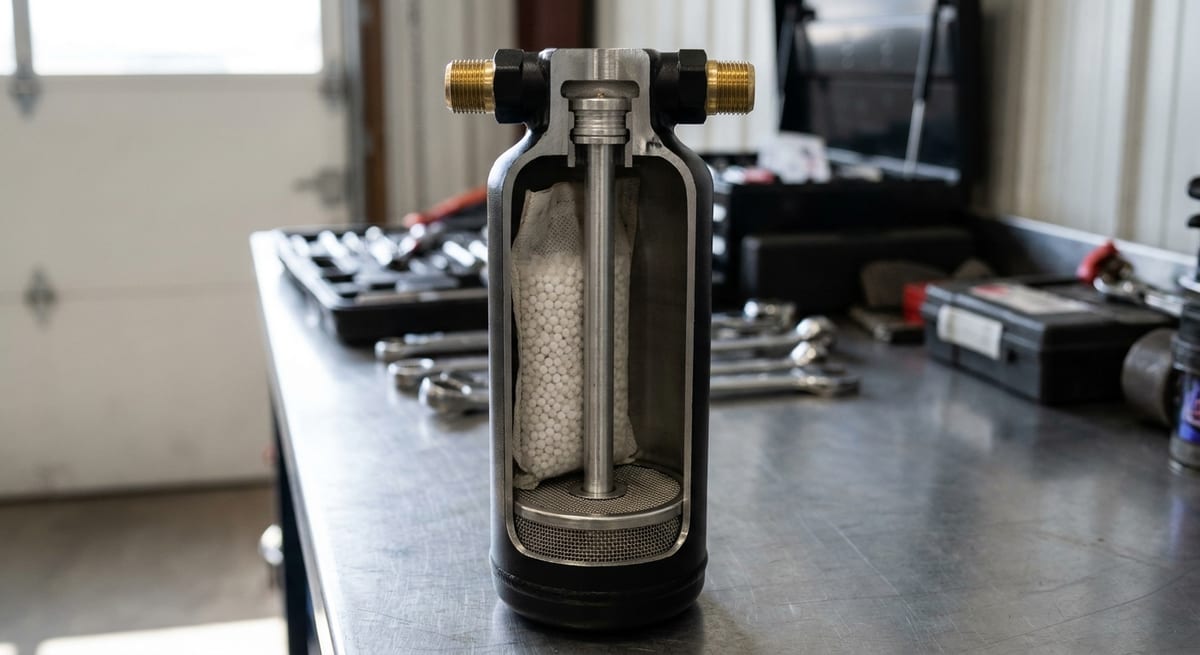
The receiver drier sits between the AC condenser and the evaporator, on the high-pressure side. Refrigerant arrives as a liquid after the condenser has done its work.
Its receiver function separates gas from liquid so that only liquid refrigerant is fed forward to the evaporator. Its drier function holds the desiccant that pulls moisture out of the refrigerant, and it filters debris on the way through. It also holds a reserve of liquid refrigerant, so supply to the metering device stays steady as demand changes.
The Accumulator on the Low Side
The accumulator sits after the evaporator, on the low-pressure side, and it filters a gas rather than a liquid.
Its priority is keeping liquid refrigerant out of the compressor. Refrigerant that leaves the evaporator without fully boiling off collects in the accumulator instead of reaching the compressor inlet, where liquid does not compress, and damage follows quickly. It carries desiccant for the same moisture duty as the drier, and it is usually a good deal larger than a receiver drier because it has to hold that liquid.
Expansion Valve or Orifice Tube Decides Which You Have
This is the quickest way to tell which part belongs on the truck, and it takes one look under the hood.
A system metered by a thermostatic expansion valve uses a receiver drier. A system metered by a fixed orifice tube uses an accumulator. The two architectures are not mixed, so identifying the metering device identifies the drier. If the system uses an expansion valve, the differences between valve types are covered in block valve vs. conventional expansion valve, and the valves themselves are on the truck AC expansion valve page.
In an orifice tube system, the tube itself takes on part of the filtering duty while it restricts flow, which is one reason the two layouts handle debris differently.
Why a Receiver Drier and an Accumulator Are Never Interchangeable
A system runs one or the other, never both, and swapping them is not a modification that works.
Fit a receiver drier where an accumulator belongs, and nothing is protecting the compressor inlet from liquid refrigerant. Fit an accumulator where a receiver drier belongs, and the metering device is no longer being fed the steady liquid supply it was designed around. In both directions, the compressor is the part that pays, and that repair costs many times what the correct part would have.
Signs the Desiccant Is Saturated
A saturated or failing unit does not announce itself clearly, but there are three things worth listening and looking for.
Rattling from the part when the AC is running points to loose or broken material inside it. Cooling that fades and does not come back after a proper recharge suggests moisture or restriction in the circuit. Oily residue around the fittings is refrigerant escaping and leaving its oil behind, which usually means the seal at that joint rather than the part itself, and the material choice behind those seals is covered on the truck O-ring page.
None of these is conclusive on its own, which is why diagnosis works through the system rather than the part. The broader symptom list is in 8 causes of a semi truck AC blowing warm air.
When Replacement Is Not Optional
There are three situations where the part gets replaced as a matter of course, not as a judgment call.
Replace it whenever the compressor is replaced. Replace it whenever the system has been open to the atmosphere for an extended period. Replace it whenever sealant or system debris is present, because that material does not stay where it is found.
The reason is the desiccant. It begins absorbing moisture from the air the moment the part is unsealed, and the working guidance is that a unit left open beyond roughly ten to fifteen minutes should not be installed. That applies to the new part on the bench as much as the old one on the truck, so it comes out of its packaging last. The rest of the parts list that goes with a compressor job is in what else to replace with an AC compressor on a truck, including the oil charge covered on the truck AC lubricant page.
Ordering the Correct Receiver Drier for Your Truck
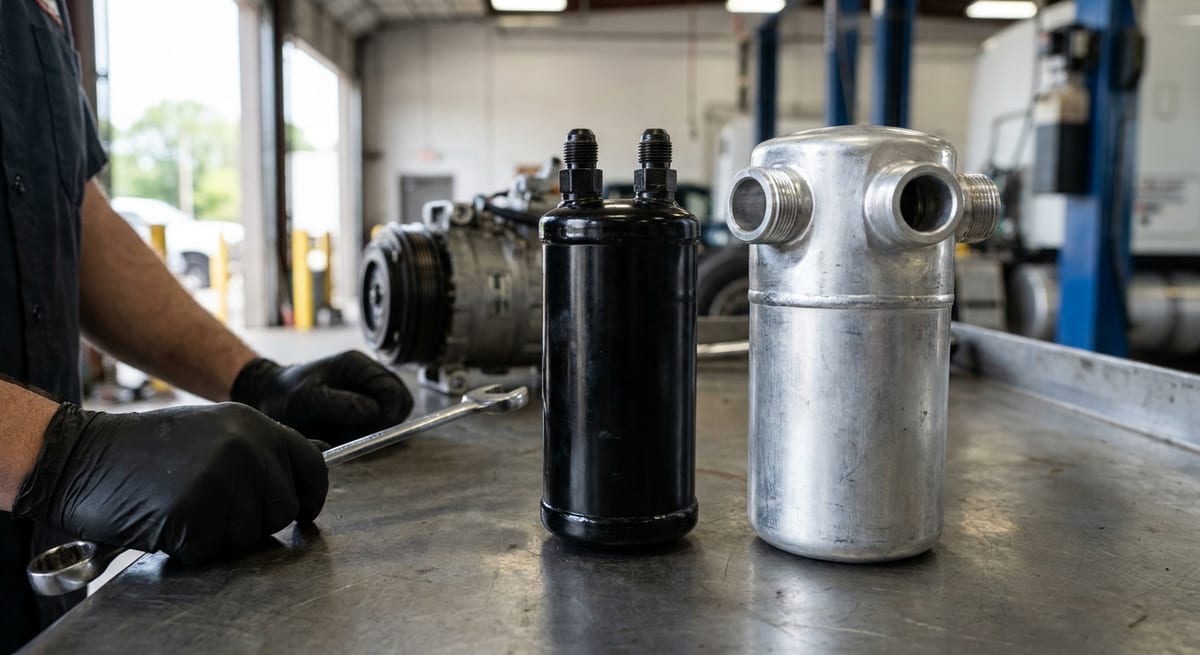
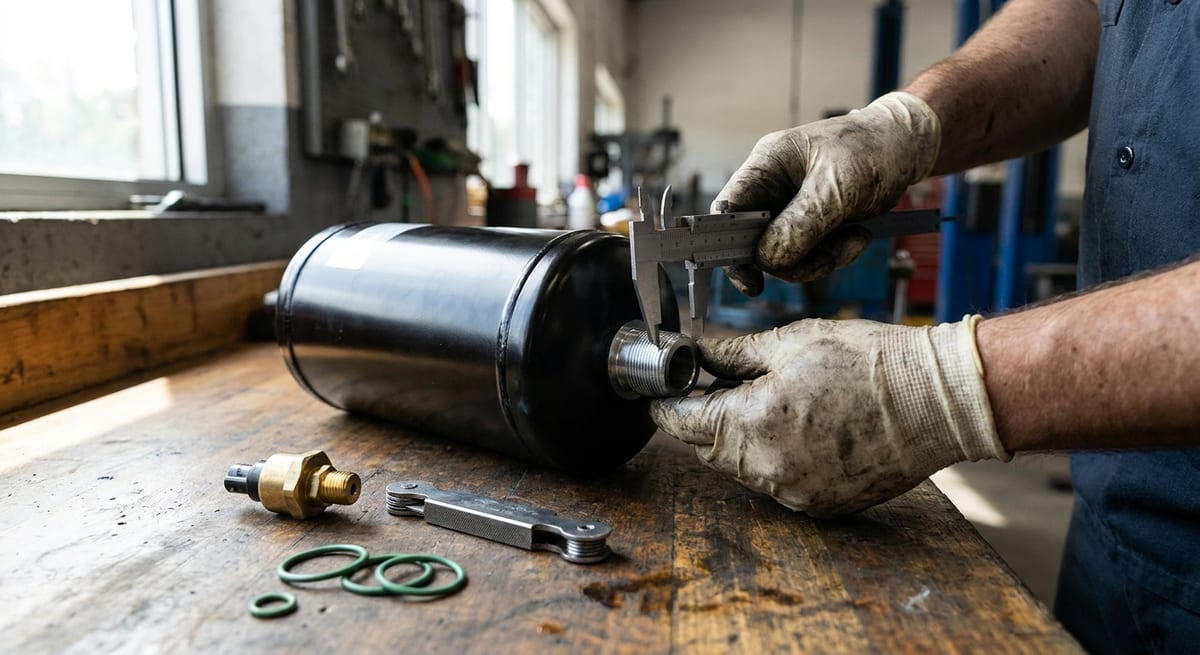
Work through four things in order. Identify the metering device, which tells you whether you need a receiver drier or an accumulator. Confirm the fitting sizes and port orientation. Check whether the unit carries a pressure switch port, since many do and a blank body will leave you without somewhere to mount the AC switch. Then confirm the mounting bracket geometry.
If the compressor is being replaced in the same job, order the two together along with the seals, and plan the sequence so the drier is the last thing unsealed. Replacement truck AC compressors are listed alongside the driers, and filtering by truck make narrows the options before you start comparing fittings.
Frequently Asked Questions
Does my truck have a receiver drier or an accumulator?
Look at the metering device. An expansion valve system uses a receiver drier on the high side. A fixed orifice tube system uses an accumulator on the low side.
Can I fit an accumulator in place of a receiver drier?
No. They sit on opposite sides of the system and do different work there. Fitting the wrong one leaves either the compressor or the metering device unprotected.
Do I have to replace the drier when I replace the compressor?
Yes. It is replaced whenever the compressor is replaced, whenever the system has been open for an extended period, and whenever sealant or debris is present.
How long can a new drier sit open before fitting?
Not long. The desiccant starts absorbing moisture as soon as the part is unsealed, and a unit left open beyond roughly ten to fifteen minutes should not be installed.
Why is an accumulator bigger than a receiver drier?
Because it has to hold liquid refrigerant that did not boil off in the evaporator and keep it away from the compressor inlet, on top of carrying desiccant.
What does a rattling noise from the drier mean?
Loose or broken material inside the unit. It is replaced rather than investigated, and the system is checked for the debris that came off it.
Not sure which one your system takes? Tell us the truck and whether it runs an expansion valve or an orifice tube, and we will match the part before it ships.

Write A Comment