
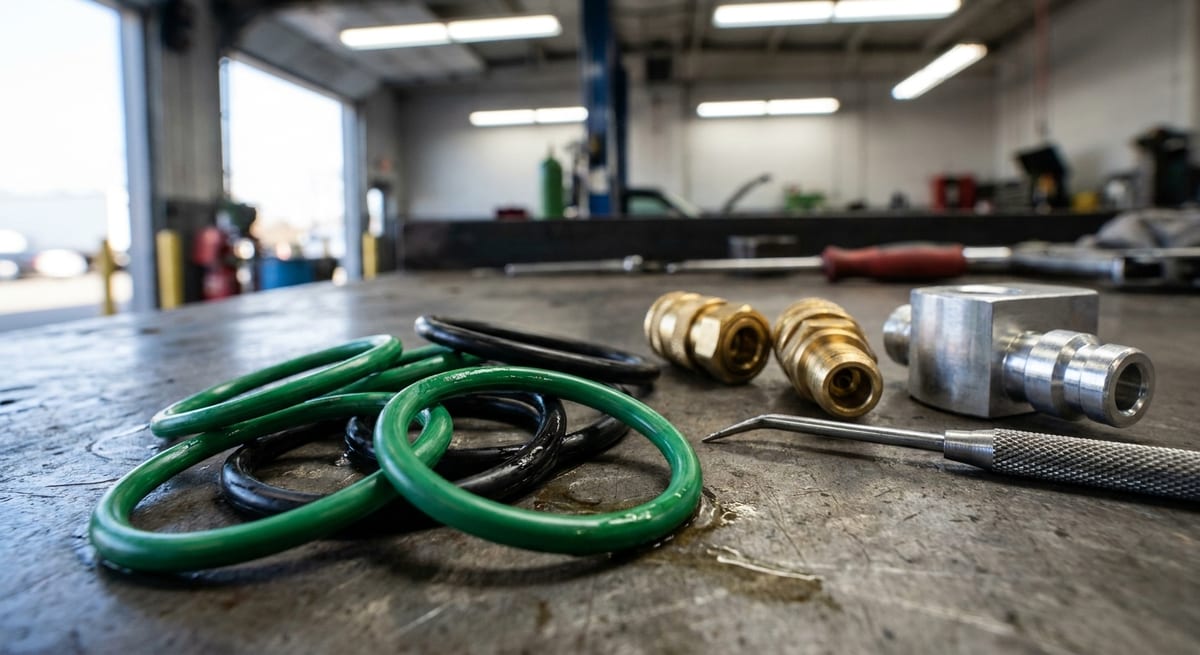
A refrigerant leak on a Class 8 truck rarely starts at the compressor. It starts at a fitting, and the part that failed is usually a two-dollar seal. If the AC went warm a few weeks after a repair, the truck AC O-rings are the first thing worth pulling apart, because the wrong rubber in a refrigerant line will weep from the day it goes in. The symptom looks the same as half a dozen other faults covered in 8 causes of a semi truck AC blowing warm air, but the fix is a lot cheaper.
What an AC O-Ring Seals on a Truck
Every joint in the refrigerant loop is a potential leak path. On a sleeper tractor, that means the compressor suction and discharge ports, both ends of the condenser, the evaporator inlet at the expansion valve, the drier fittings, and every coupling along the way. The seal has to hold refrigerant that is under a few hundred psi on the high side, survive underhood heat, and sit in PAG oil for years without swelling or going hard.
That is a harder service life than most rubber handles. It is why the material matters more than the size.
Nitrile (NBR) vs. HNBR: The Material Difference
Standard nitrile, also called NBR or Buna-N, is the black rubber used across the industry for fuel and oil sealing. It is cheap, it is everywhere in a shop drawer, and it is the wrong choice for a modern AC system.
What Refrigerant Does to a Standard Seal
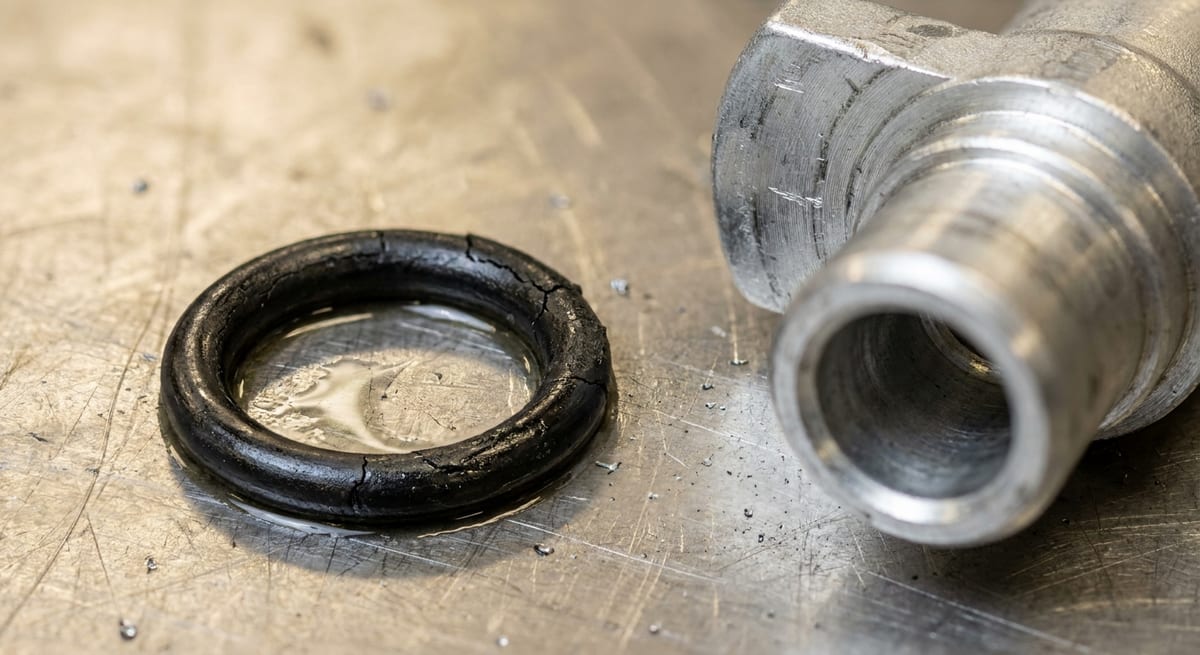
Refrigerant attacks standard nitrile. The seal does not blow out in one go. It hardens, loses its ability to spring back against the fitting, and starts to weep. The system holds a charge through the first hot week and then does not, which is how a repair that looked finished comes back as a comeback.
Why the Hydrogenated Version Holds Up
Hydrogenating the nitrile changes its chemistry enough to live in refrigerant and synthetic oil. HNBR handles R-134a, R-1234yf, and the PAG and POE oils that circulate with them. It also has higher mechanical strength, which keeps it from extruding out of the groove under high-side pressure and wearing at the contact face. Those two properties are the whole reason the industry moved to it.
Reading AC O-Ring Colour: Black, Green, and Blue
Colour is a useful first read, though it is not a specification.
Before 1987, mobile AC O-rings for R-12 were almost all black, and many of them were plain nitrile. When R-134a arrived, the industry needed a way to keep technicians from grabbing the old black seals, so coloured versions appeared. Blue O-rings were coated specifically so they could not be confused with the black nitrile seals that are not suitable for R-134a. Green became the common marker for HNBR, sometimes labelled HSN or highly saturated nitrile on the packet.
Treat colour as a prompt to check the label, not as proof. Some suppliers ship HNBR in other colours, and a black seal out of an unmarked bin tells you nothing at all.
Matching the Seal to R-134a, R-1234yf, and PAG Oil
For any truck AC system in service today, HNBR is the default. It is rated for both refrigerants in use and for the oils that travel with them, so one material covers a mixed fleet without the risk of a mismatch. The oil side of that pairing sits on the truck AC lubricant page.
Where it gets expensive is the drawer of generic black seals that every shop has. They will fit. They will seal for a while. They will also put the same truck back in the bay in a month, with another evacuation and recharge on the bill.
Where Truck AC O-Rings Leak First
Vibration and heat decide the order. The joints that move most and run hottest go first:
- Compressor discharge fitting, the hottest joint in the loop
- Compressor suction fitting, which sees the most vibration
- Both ends of the AC condenser, out front and exposed to road debris
- The evaporator inlet at the expansion valve, where the line crosses the firewall
- The AC drier fittings, often disturbed during other repairs and reassembled with the old seal
An oily film around a fitting is the tell. Refrigerant carries oil with it, so when it escapes, it leaves the oil behind as a dark, dust-collecting ring. If the residue sits at a coupling rather than on the component itself, the seal is the suspect and not the part. The same logic applies to a weeping hose, which is covered on the truck AC line page.
Installing a New Seal Without Damaging It
Most seals that fail early were damaged on the way in.
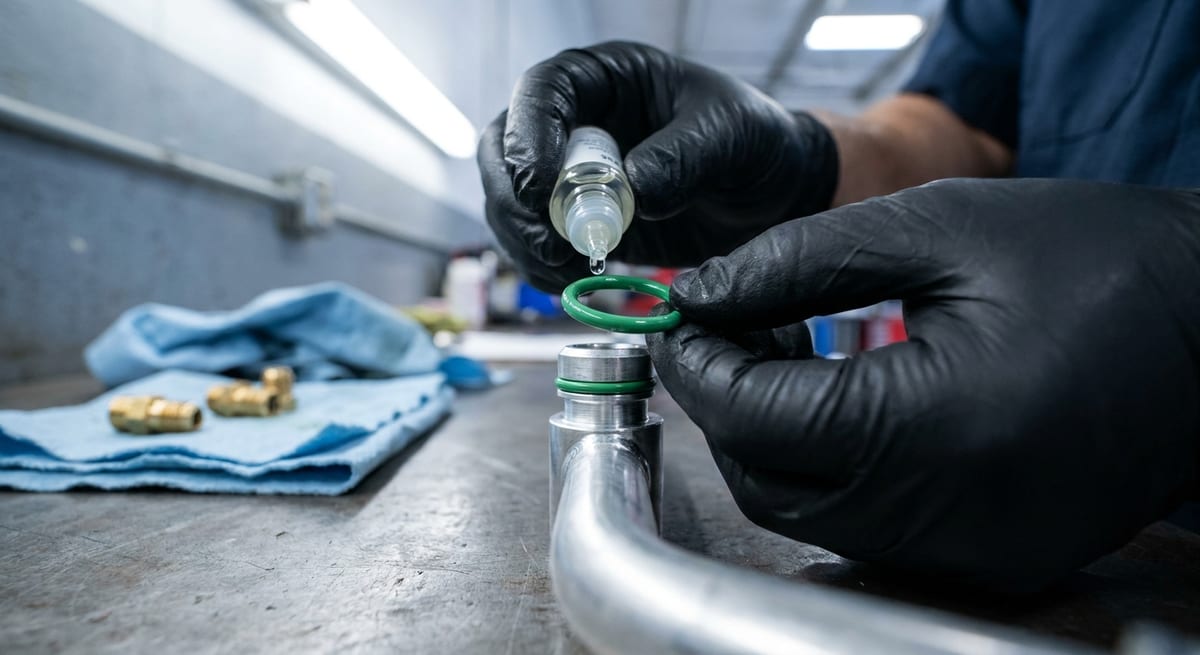
Lubricate every new O-ring with the correct AC oil before it goes on. A dry seal drags across the fitting threads and picks up a nick that is too small to see and large enough to leak. Use the same oil the system runs on, not grease and not assembly lube.
Then check the groove. A scored or corroded sealing face will leak even with a perfect seal in it. Clean it, inspect it, and replace the fitting if the surface is pitted.
One more thing worth saying plainly: recovering refrigerant is not optional and not a job for a set of pliers and a rag. It is recovered with a machine before the joint comes apart.
Buying Truck AC O-Rings by Size and Fitting Type
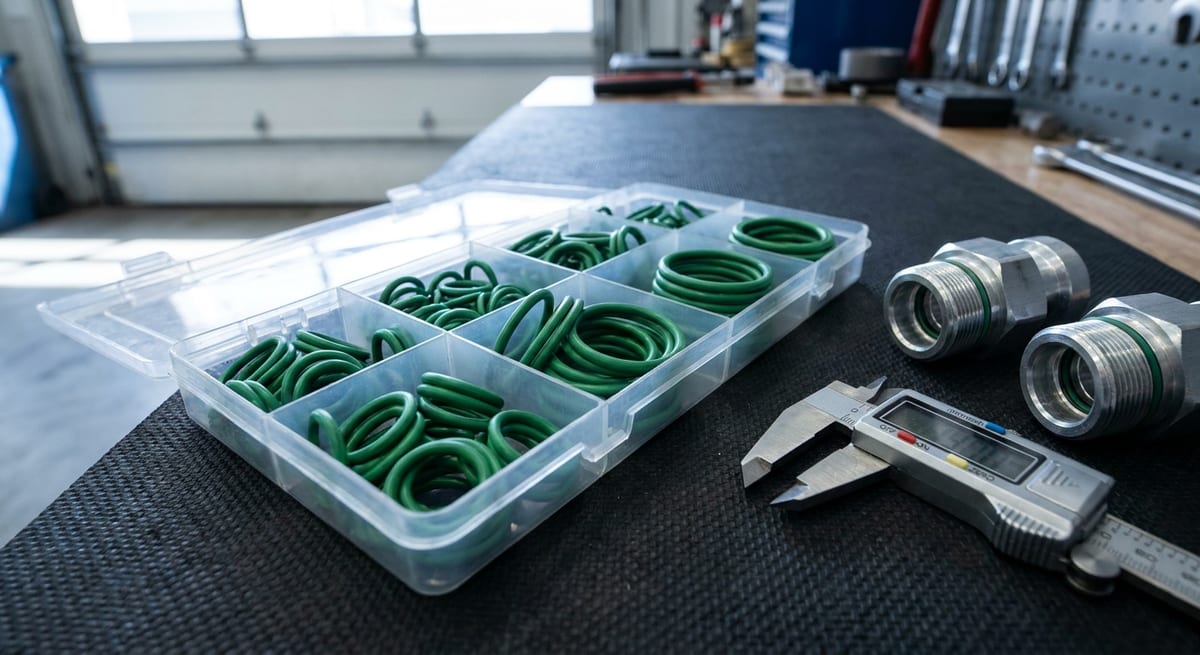
Order by fitting size and seal material together. A seal in the wrong rubber is as useless as the right rubber in the wrong size, and on a heavy truck the fitting sizes run larger than anything on a pickup, so automotive kits often come up short. Filtering by truck make narrows it faster than working from a generic kit.
If the system has been open for a repair, the seals are a small line on a larger list. The parts that have to go back together with it are set out in what else to replace with an AC compressor on a truck, and the matching truck AC compressors sit alongside the seal kits.
Frequently Asked Questions
Can I use a black nitrile O-ring in a truck AC system?
No. Refrigerant degrades standard nitrile, so the seal hardens and starts to weep. It may hold for a few weeks, which is what makes it a costly shortcut rather than an obvious one.
Are green O-rings always HNBR?
Green is the common marker for HNBR, but colour is a convention and not a standard. Confirm the material on the packaging rather than going by the colour in the bin.
Does HNBR work with both R-134a and R-1234yf?
Yes. HNBR is compatible with both refrigerants and with the PAG and POE oils used with them, which is why one material covers a mixed fleet.
Do I need to oil the O-ring before fitting it?
Yes. Every new seal gets a film of the correct AC oil before assembly. A dry seal is easy to nick on the fitting, and a nicked seal leaks.
Why does my AC leak again after a repair?
The two usual reasons are a seal in the wrong material and a damaged sealing surface. Check the material first, then inspect the groove on the fitting before fitting another O-ring.
Can I reuse an O-ring if it still looks fine?
No. A used seal has already taken a compression set against that fitting and will not seal the same way twice. Seals are replaced whenever a joint is opened.
Need the right seal the first time? Our team matches O-rings by fitting size and system, so the repair holds. Send us the truck and the joint you are sealing.
Write A Comment