
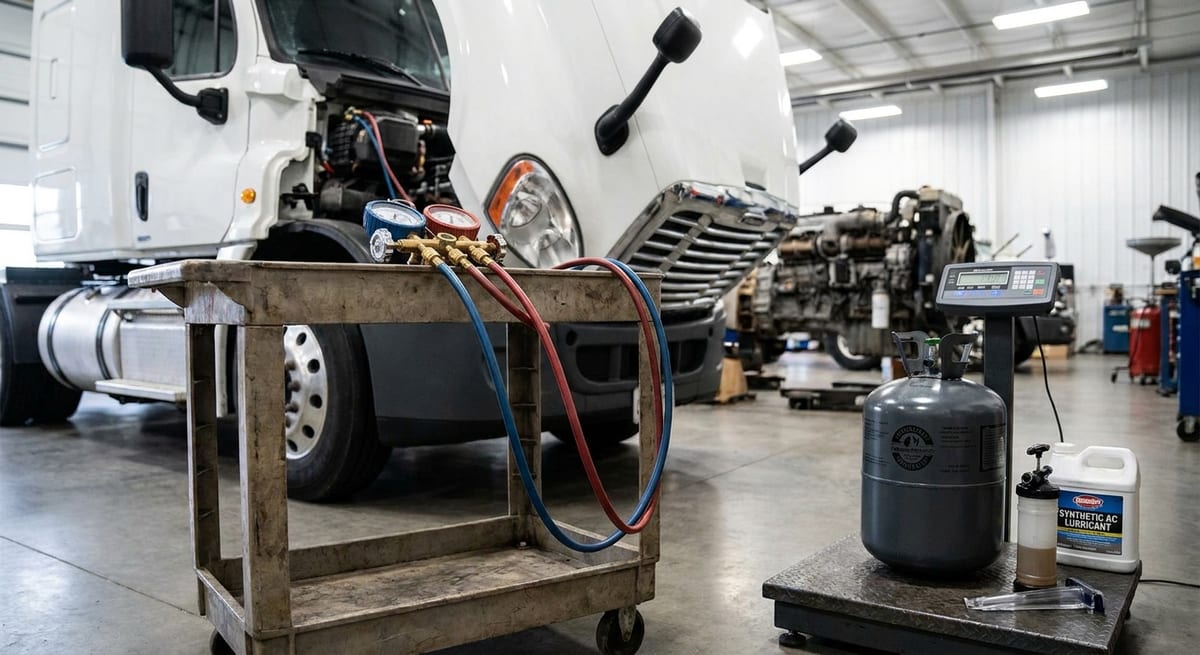
Charging by the can is guesswork, and truck AC lubricant is where that guess usually goes wrong. Refrigerant gets the attention, but oil is the half of the charge that decides whether the compressor survives the season. Both are specified by weight, and both are listed on the same OEM capacity chart.
Why a Semi Truck AC System Is Charged by Weight
A heavy-duty system holds several pounds of refrigerant across long lines, a large condenser, and in many trucks a second evaporator for the sleeper. That volume is exactly why guessing fails: there is enough capacity in the system to swallow a can without the gauges moving much, and enough to be overcharged by one can too many.
Undercharge and the evaporator runs short of liquid refrigerant, cooling drops off, and the oil that travels with the refrigerant stops reaching the compressor. Overcharge and head pressure climbs, the high side runs hot, and the compressor works against pressure it was not designed to see. Neither condition announces itself clearly from the vents, which is why the only reliable method is to recover, evacuate, and charge the specified weight.
What the Refrigerant Capacity Charts List
Capacity is set by the HVAC configuration, not by the badge on the hood. Published manufacturer capacity charts group it by cab type and HVAC module, and the spread is wide.
On one OEM chart, the figures run from roughly 24 oz for a medium-duty chassis module up to about 62 oz for a day cab with a larger system, with sleeper configurations sitting between the two at around 45 oz. A bus or coach module on the same chart is listed separately again. That range is the whole argument against a rule of thumb: two trucks in the same yard can be nearly 40 oz apart.
Where to Find the Number for a Specific Truck
Three places, in order of reliability. The underhood decal, if it is still legible and the system has not been modified. The service manual or the manufacturer capacity chart for that HVAC module. The dealer parts counter, using the VIN.
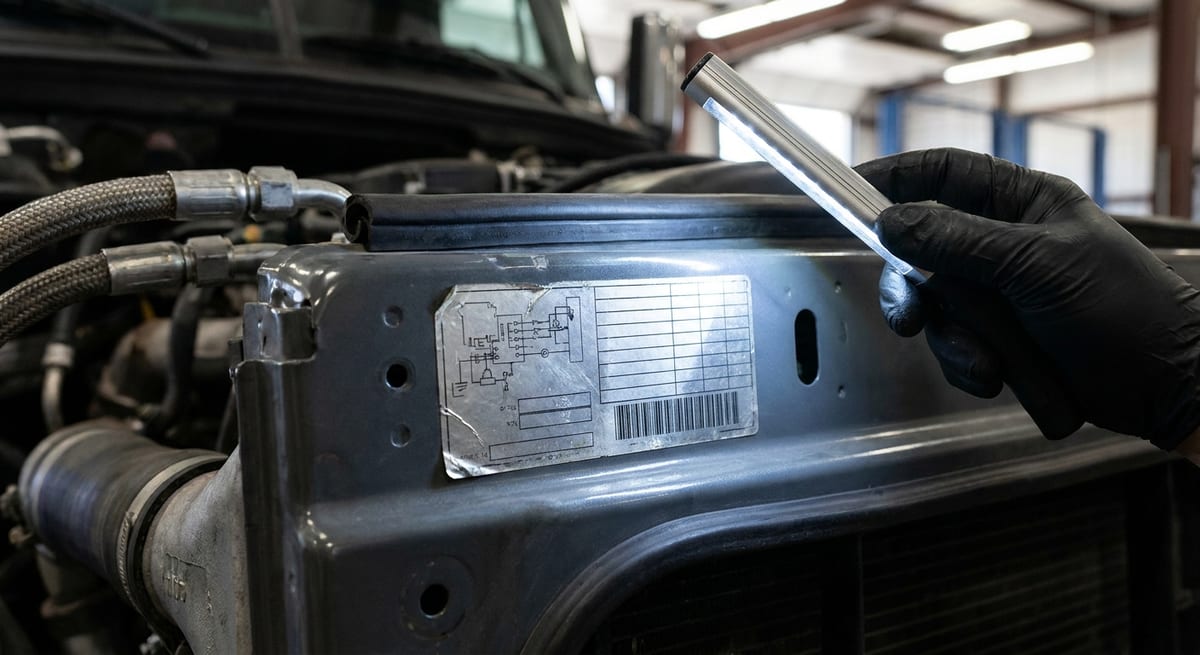
What does not count: a figure from a forum post about a similar truck, or the capacity of the last truck that came through the bay.
How Much PAG Oil Goes Back In
Oil is the part that gets skipped, and it is the part that kills compressors.
Refrigerant carries the oil around the loop, so when refrigerant escapes, oil goes with it. Any component that comes off the truck takes a share of the system oil with it, and that share has to be put back, or the compressor runs short from the first minute.
One OEM capacity chart lists the split by component: around 200 cc in the compressor, 60 cc in the evaporator, 30 cc in the condenser, and 15 cc in the filter drier. The same chart specifies PAG 46 as the oil type for those systems. Converted to the units on the bottle, that is roughly 6.8 oz, 2 oz, 1 oz, and 0.5 oz.
Adjusting the Charge When Only One Part Is Replaced
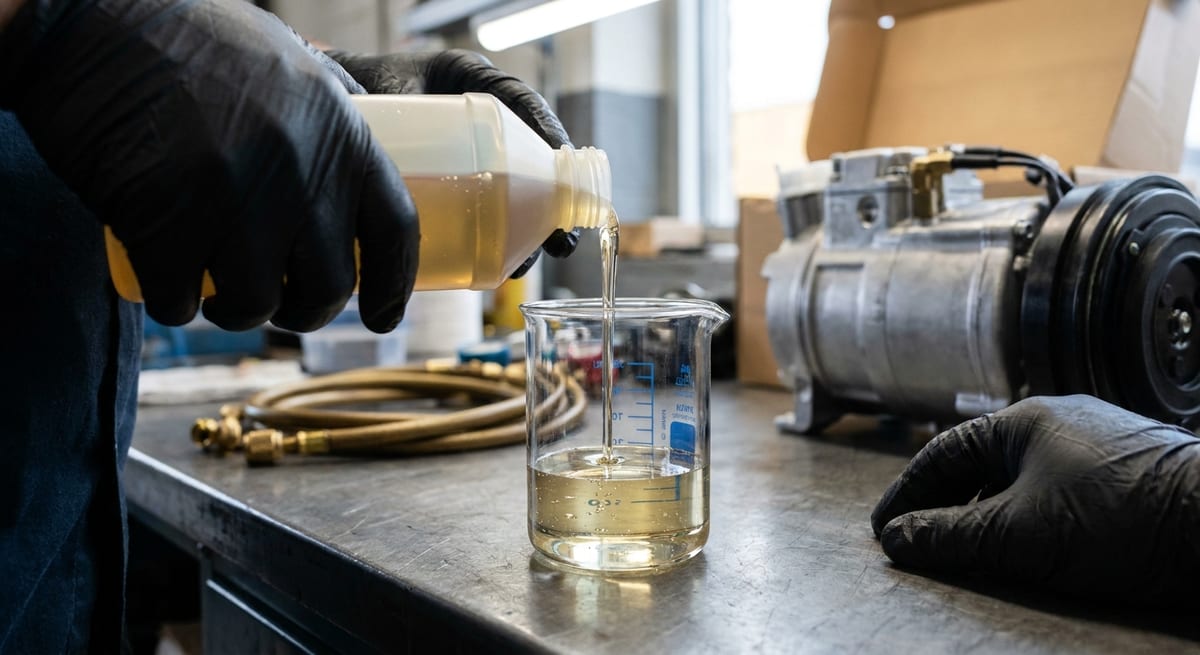
The chart gives total system capacity, not what to pour into a new part. The working method is to drain the old component, measure what comes out, and put that amount into the new one. If the old part was dry because the system had been leaking for months, fall back on the chart figure for that component.
A new compressor is the exception worth checking: many ship with a full oil charge for shipping protection, so the correct step is to drain it and refill with the measured amount rather than adding on top. The rest of the parts list for that job is set out in what else to replace with an AC compressor on a truck.
Matching the Oil Type to the Refrigerant
PAG oil is specified by viscosity grade, and the grade is not interchangeable across systems. The capacity chart that gives the quantity also gives the grade, and that is the one to follow.
The pairing matters because the oil has to stay miscible with the refrigerant in the system it is running in. Topping up with whatever PAG is open on the shelf puts the wrong viscosity into circulation, and the compressor is the component that finds out first. If the system is being opened anyway, the AC drier comes out at the same time, since its desiccant has already taken on moisture.
What Happens With Too Much Oil
Excess oil does not improve lubrication. It coats the inside of the evaporator and condenser, where it insulates the tube walls and cuts heat transfer. The system then cools poorly for a reason that no gauge reading explains, and the usual response is to add refrigerant, which makes it worse.
If a system has had repeated top-ups over the years, oil accumulation is worth considering before anything is replaced.
Ordering Parts for a Full Recharge
A recharge that follows a repair needs the oil, the seals, and the drier on the bench before the system is opened, because every minute the system sits open is moisture going into the desiccant. The seal material also has to match the refrigerant, which is covered in AC O-rings for trucks, and the fittings themselves sit on the truck AC line page.
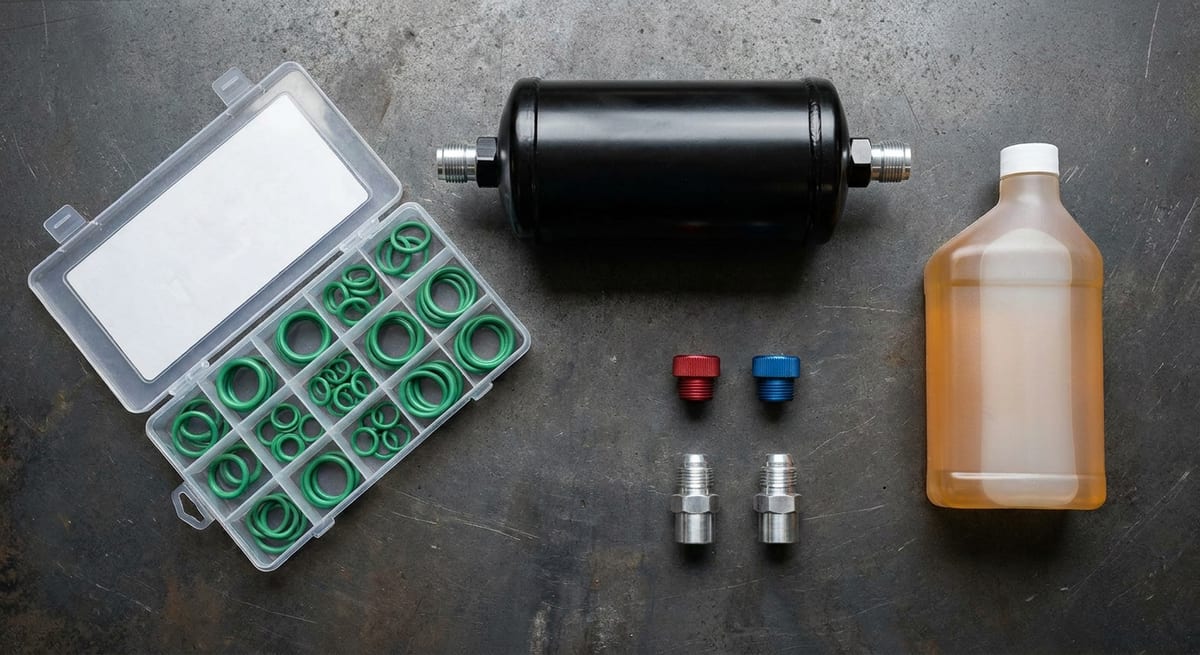
If the system was low because of a leak rather than normal seepage, find the leak first. Charging a known leaker to spec is a way of paying for refrigerant twice. Filtering by truck make narrows the parts list before you start cross-referencing fittings.
Frequently Asked Questions
Can I just add a can of R-134a to top up the system?
You can, but you will not know what is in the system afterwards. Capacity is specified by weight, and a partial charge of unknown quantity cannot be verified against the chart.
How much refrigerant does a sleeper cab hold compared to a day cab?
It varies by HVAC module rather than by cab alone. On one published chart, the range across configurations runs from about 24 oz to about 62 oz, so the module specification is what to go by.
Do I need to add oil every time I recharge?
Only if oil left the system. A routine evacuation and recharge with no components removed and no significant leak does not need an oil addition.
What happens if I use the wrong PAG grade?
The oil has to stay miscible with the refrigerant in that system. The wrong viscosity circulates poorly, and the compressor is the first part to suffer from it.
How do I know how much oil to put in a new compressor?
Drain the old unit, measure what comes out, and put that amount into the new one. Many new compressors ship with a full oil charge that has to be drained first.
Why is my AC cooling poorly after several top-ups?
Accumulated oil is one explanation. Excess oil coats the evaporator and condenser tubes and reduces heat transfer, and adding more refrigerant makes the symptom worse rather than better.
Not sure what your system takes? Send us the truck and the HVAC configuration, and we will confirm the capacity and the oil grade before you order.

Write A Comment