
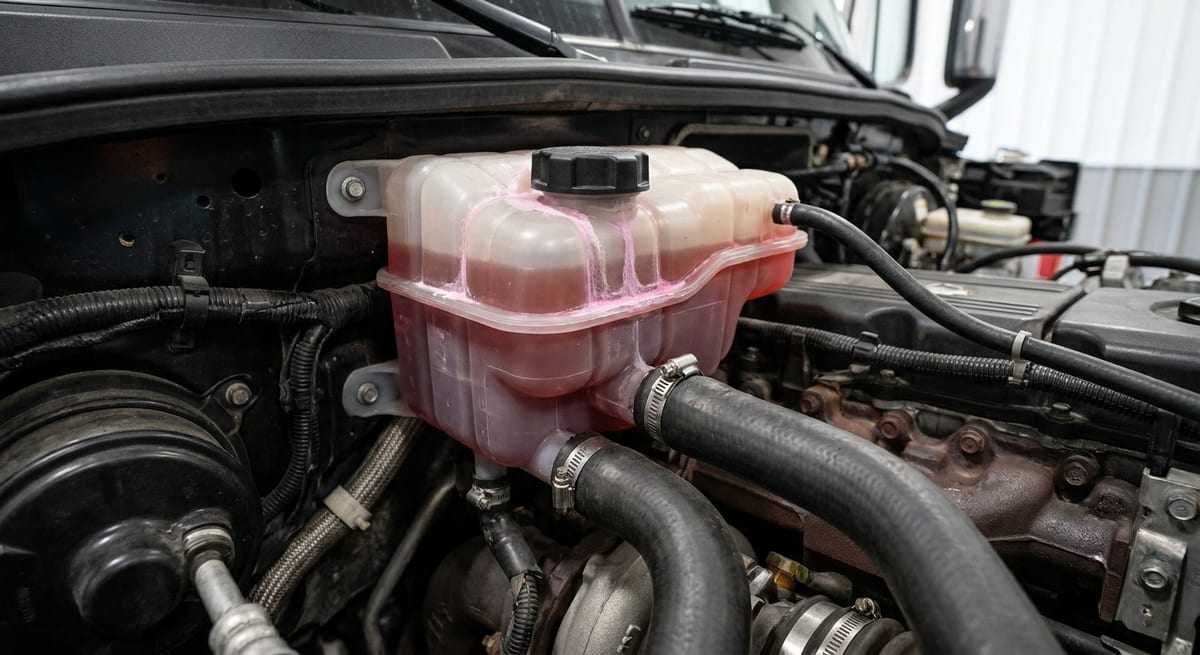
Slow coolant loss with nothing on the ground under the truck is one of the more frustrating faults to chase. The level drops a little every few days, the gauge stays where it should, and there is no puddle to point at. More often than not, the answer is at the top of the cooling system rather than the bottom, which is why the coolant reservoir tank is worth checking before anyone starts talking about head gaskets. A hairline crack or a cap that no longer holds pressure will lose coolant as vapour and leave almost nothing behind.
What the Coolant Surge Tank Does on a Semi Truck
The tank is not an overflow bottle. On a heavy-duty cooling system, it is a pressurised part of the circuit, and it does three jobs at once.
It gives hot coolant somewhere to expand to, so the system does not over-pressurise and push a hose off. It holds the pressure the system needs, because pressure raises the boiling point of the coolant and keeps heat transfer working when the engine is loaded. And it lets trapped air separate out and work its way clear instead of sitting in the block as a hot spot.
Take away the pressure, through a crack or a tired cap, and all three of those jobs stop at once. The coolant boils sooner, air stays in the system, and the engine runs hotter under exactly the conditions where it needs the most margin. That is the same chain of events behind several of the faults listed in semi-truck overheating causes.
Where a Coolant Surge Tank Cracks
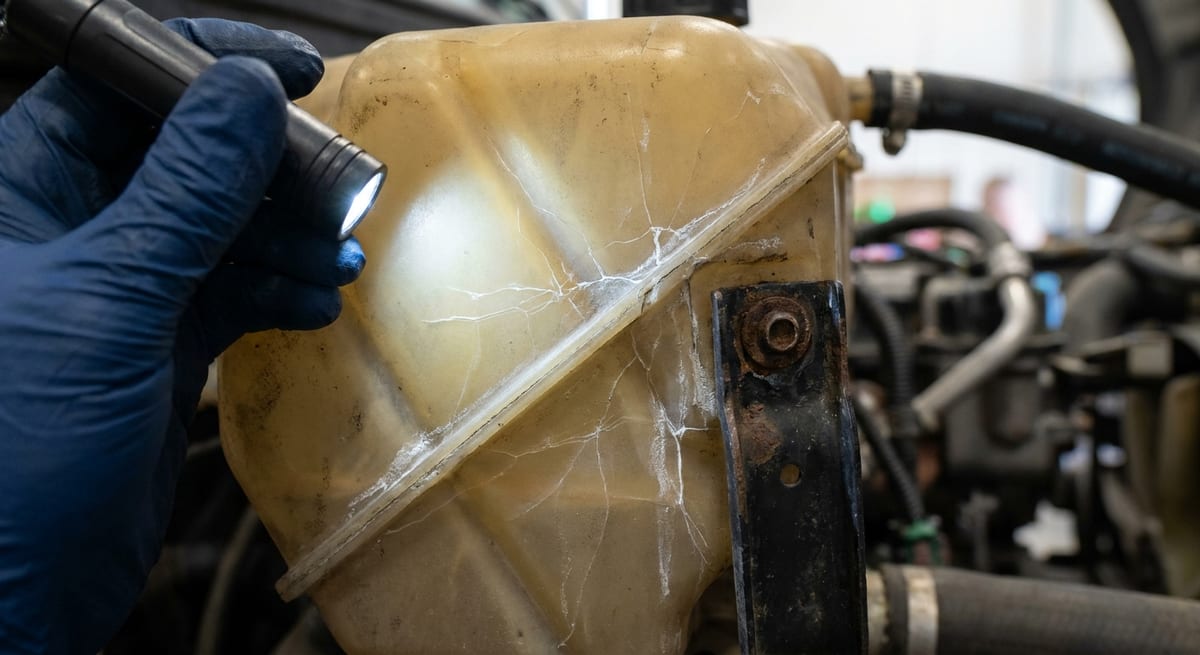
Plastic tanks fail in predictable places. Manufacturer service bulletins document cracking at the moulded seam and through the side wall, and both are the result of the same thing: years of heat cycling with pressure behind it.
Look at the seam first, running a finger along it with the engine cold. Then the side wall, especially anywhere a bracket holds the tank and concentrates stress. Then the neck around the cap, where the threads take the load every time the cap goes on.
A crack that only opens under pressure will look like nothing at all on a cold inspection. That is the one that costs people a week of guessing.
Is the Leak the Surge Tank or the Pressure Cap?
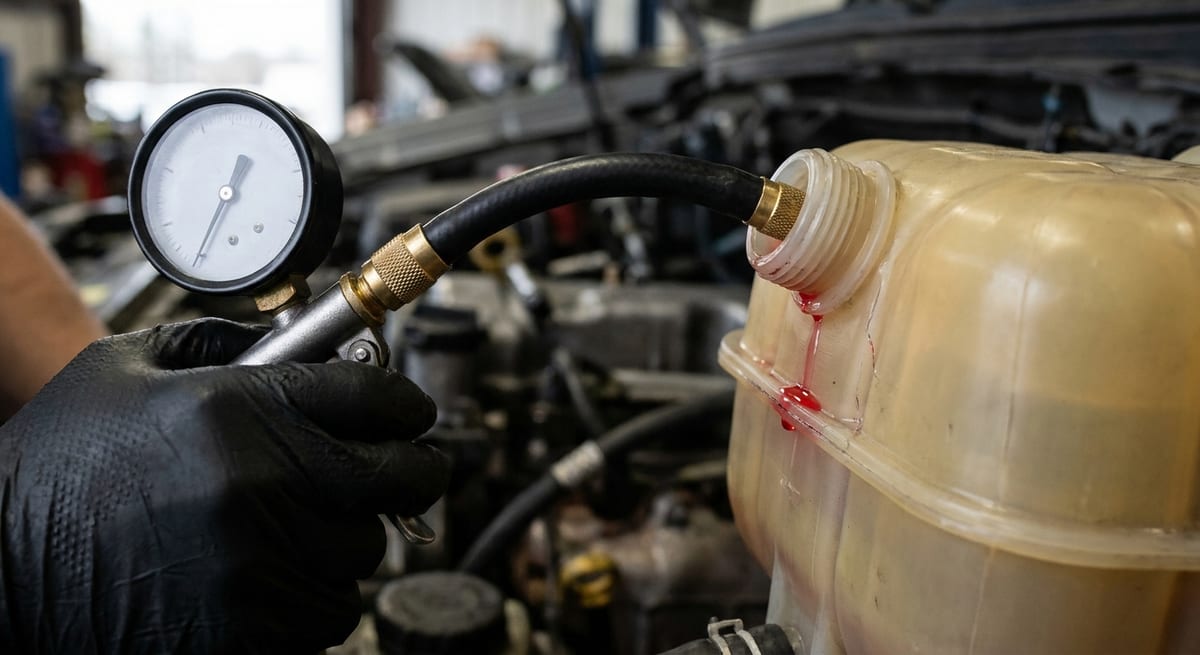
These two faults produce nearly the same symptom, and they are separated with a pressure tester rather than by eye.
Testing the Pressure Cap
The cap is the cheaper of the two, so it gets tested first. A heavy-duty cap holds pressure until it reaches its rating, commonly somewhere in the 7 to 15 psi range depending on the system, and then relieves to protect the hoses and the radiator.
Pull the cap, inspect the seal, and replace it outright if the rubber is cracked, grooved, or flattened. If it looks serviceable, fit it to a tester, pump it to its rated pressure, and watch it for two full minutes. If a cap bleeds down inside that window, it’s finished even if it looks perfect.
Check the threads and the gasket face every time you add coolant, not just when something goes wrong. It takes ten seconds, and it catches the fault before it becomes an overheat.
Pressure Testing the System
With a known-good cap, pressurise the system and look for the drop. Service bulletins caution against exceeding roughly 18 psi on the tank during this test, because the tank itself can be damaged by over-pressurising it. Stay at or under the system rating.
Hold the pressure and walk the truck. A crack that was invisible when cold will usually show a bead of coolant once there is pressure behind it. If the gauge falls and nothing shows externally, the loss is going somewhere internal, and the same tester is used for the radiator checks described in how to repair a truck radiator.
Coolant Loss With No Visible Puddle
Vapour does not leave a stain. Coolant escaping past a cap seal or through a crack that only opens hot will boil off against warm metal and leave a faint white or coloured crust rather than a drip.
Look for that residue around the cap neck, down the side of the tank, and on anything directly below it. A dry system that still drinks coolant every week is losing it as vapour somewhere, and the top of the system is where to start. If boost and intake temperatures have moved as well, the checks in signs of a failing charge air cooler are worth running at the same time.
What a Collapsing Upper Radiator Hose Tells You
If the upper hose collapses as the engine cools, the cap is holding too much vacuum. The cap has a negative pressure rating as well as a positive one, and a cap with the wrong vacuum rating will pull the hose flat instead of letting coolant return from the tank.
This is a known failure mode documented in manufacturer bulletins, where a cap with too high a negative rating was replaced by one rated lower to stop the hose collapsing. A collapsed hose can contact belts and pulleys and wear through, so it is worth fixing on sight rather than at the next service.
Replacing a Leaking Surge Tank
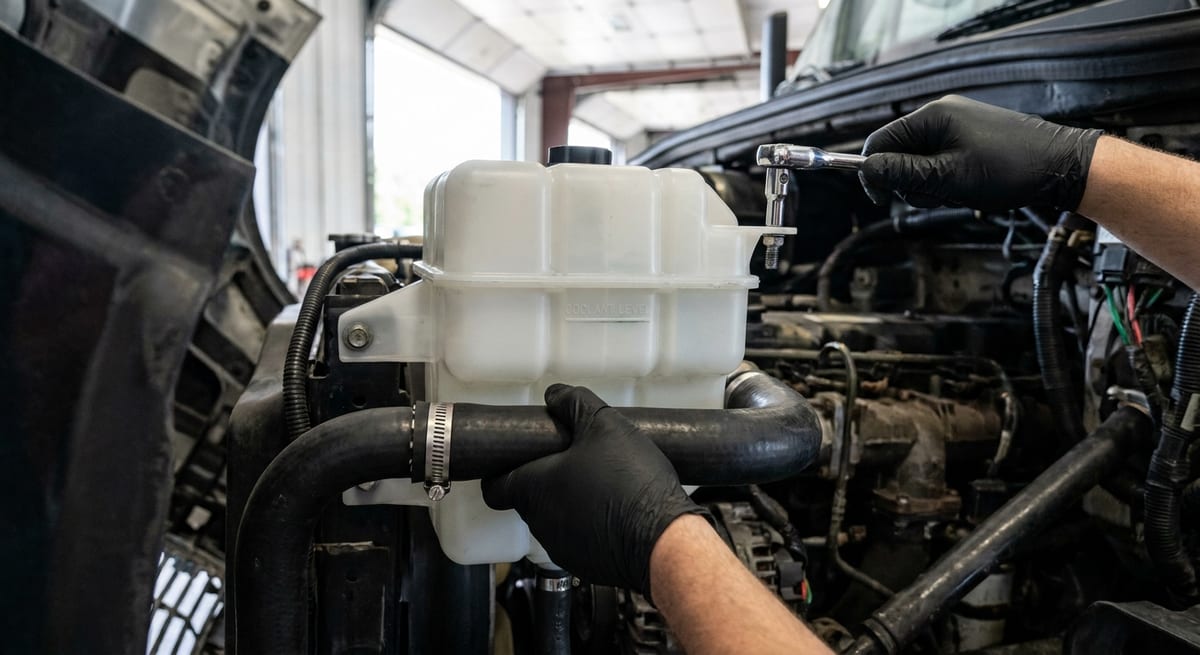
A cracked tank is replaced, not repaired. Epoxy on a pressurised plastic part under constant heat cycling buys days, not months.
While the tank is out, deal with the pressure protection valve at the same time. Service bulletins covering tank replacement call for that valve to be cleaned or replaced alongside the new tank, because debris from the old failure tends to end up in it.
Refill through the tank, run the engine up to temperature, and check the level again once everything has cooled. Air that was trapped in the system will work its way up, and the level will drop on the first proper heat cycle. That is normal, and it is not a second leak.
Choosing a Replacement Coolant Surge Tank
Match the tank to the cooling system rather than to a photograph. The things that have to line up are the mounting position and bracket geometry, the hose port sizes and their orientation, the cap type and its pressure rating, and whether the tank carries a low coolant level sensor. Working from your truck make is the quickest way to shorten that list.
A tank that fits the brackets but takes a different cap rating will run the whole system at the wrong pressure, which is a slower and more expensive version of the fault that was just fixed. If the radiator has been apart as part of the same job, replacement truck radiators and charge air coolers sit alongside the tanks.
One more number worth putting on the decision: a truck parked waiting for a cooling part is costing money every hour it sits. The fleet downtime calculator turns that into a figure you can compare against the price of stocking the part.
Frequently Asked Questions
Can I drive with a cracked coolant surge tank?
Not for long. The system cannot hold pressure with a crack in it, so the coolant boils at a lower temperature and the engine loses its heat margin exactly when it is working hardest.
Why does my truck lose coolant with no visible leak?
Coolant lost as vapour past a cap seal or through a crack that opens only under pressure leaves no puddle. A pressure test with a known-good cap is what finds it.
How do I know if it is the cap or the tank?
Test the cap on its own first, holding it at its rated pressure for two minutes. If the cap holds, pressurise the system and look for the drop.
What pressure should I test the system at?
Stay at or below the system rating. Service bulletins warn against exceeding roughly 18 psi on the tank, since over-pressurising can damage the tank itself.
Can a cracked tank be repaired instead of replaced?
No. It is a pressurised plastic part under constant heat cycling, and a patch will not survive those conditions.
Why did my upper radiator hose collapse?
The cap is holding too much vacuum as the system cools. Caps carry a negative pressure rating as well as a positive one, and the wrong rating pulls the hose flat.
Not sure which tank your cooling system takes? Send us the truck details, and we will match the ports, bracket, and cap rating before anything ships.

Write A Comment